Ashwani Kumar
Job Title
Associate Professor
Employer
Mount Saint Vincent University
Review details about the recently announced changes to study and work permits that apply to master’s and doctoral degree students. Read more
The Curriculum Studies program is designed to promote students’ exposure and engagement with a variety of perspectives, orientations, and research related to the field of Curriculum Studies. It supports students in pursuing inquiries and research in curriculum studies, curriculum theory and teacher education.
In the Department of Curriculum and Pedagogy, curriculum studies refers to studies in single subjects (mathematics, science, art etc.), studies in the history and politics of curriculum, studies in teaching (Indigenous pedagogies etc.), technology (Artificial Intelligence, digitalization etc.), and teacher education. Courses invite graduate students to extend their understanding of curriculum beyond a strictly organizational sense in order to appreciate its broader links to society (e.g., curriculum as instrument of settler colonialism and patriarchy), historical periods and movements (e.g., globalization, neoliberalism), subjectivity (i.e., how curriculum influences what it is possible to think and feel) and popular culture (e.g., mass media as curriculum). As such, inquiry in curriculum studies draws on an array of perspectives including anti-oppressive education, decolonial studies, post structuralism, semiotics and feminism. Drawing on these and other orientations, the goal is to advance student knowledge while deepening understanding and critical engagement with what curriculum is up to and what it makes of us as we navigate K-12 schooling, continuing and third-level education, and public discourse. A key strength of the program is its flexibility and ability to meet the interests of prospective students in a variety of frameworks, approaches and potential research projects.
The Faculty of Graduate and Postdoctoral Studies establishes the minimum admission requirements common to all applicants, usually a minimum overall average in the B+ range (76% at UBC). The graduate program that you are applying to may have additional requirements. Please review the specific requirements for applicants with credentials from institutions in:
Each program may set higher academic minimum requirements. Please review the program website carefully to understand the program requirements. Meeting the minimum requirements does not guarantee admission as it is a competitive process.
Applicants from a university outside Canada in which English is not the primary language of instruction must provide results of an English language proficiency examination as part of their application. Tests must have been taken within the last 24 months at the time of submission of your application.
Minimum requirements for the two most common English language proficiency tests to apply to this program are listed below:
Overall score requirement: 92
Reading
22
Writing
22
Speaking
22
Listening
22
Overall score requirement: 6.5
Reading
6.0
Writing
6.0
Speaking
6.0
Listening
6.0
Some programs require additional test scores such as the Graduate Record Examination (GRE) or the Graduate Management Test (GMAT). The requirements for this program are:
The GRE is not required.
A Master's degree with high standing in a relevant educational discipline.
All applicants have to submit transcripts from all past post-secondary study. Document submission requirements depend on whether your institution of study is within Canada or outside of Canada.
Many programs require a statement of interest, sometimes called a "statement of intent", "description of research interests" or something similar.
Students in research-based programs usually require a faculty member to function as their thesis supervisor. Please follow the instructions provided by each program whether applicants should contact faculty members.
Permanent Residents of Canada must provide a clear photocopy of both sides of the Permanent Resident card.
All applicants must complete an online application form and pay the application fee to be considered for admission to UBC.
| Fees | Canadian Citizen / Permanent Resident / Refugee / Diplomat | International |
|---|---|---|
| Application Fee | $118.50 | $168.25 |
| Tuition * | ||
| Installments per year | 3 | 3 |
| Tuition per installment | $1,912.84 | $3,360.55 |
| Tuition per year (plus annual increase, usually 2%-5%) | $5,738.52 | $10,081.65 |
| Int. Tuition Award (ITA) per year (for eligible individuals) | $3,200.00 (-) | |
| Other Fees and Costs | ||
| Student Fees (yearly) | $1,169.35 (approx.) | |
| Costs of living | Estimate your costs of living with our interactive tool in order to start developing a financial plan for your graduate studies. | |
Applicants to UBC have access to a variety of funding options, including merit-based (i.e. based on your academic performance) and need-based (i.e. based on your financial situation) opportunities.
All full-time students in UBC-Vancouver PhD programs will be provided with a funding package of at least $40,000 for each of the first four years of their PhD from September 2026. The funding package may consist of any combination of internal or external awards, teaching-related work, research assistantships, and graduate academic assistantships. Please check with your prospective graduate program for specific details of the funding provided to its PhD students.
This results in a net balance (any funding provided to the student minus tuition and fees) mean of $33,495 and median of $25,456.
All applicants are encouraged to review the awards listing to identify potential opportunities to fund their graduate education. The database lists merit-based scholarships and awards and allows for filtering by various criteria, such as domestic vs. international or degree level.
Many professors are able to provide Research Assistantships (GRA) from their research grants to support full-time graduate students studying under their supervision. The duties constitute part of the student's graduate degree requirements. A Graduate Research Assistantship is considered a form of fellowship for a period of graduate study and is therefore not covered by a collective agreement. Stipends vary widely, and are dependent on the field of study and the type of research grant from which the assistantship is being funded.
Graduate programs may have Teaching Assistantships available for registered full-time graduate students. Full teaching assistantships involve 12 hours work per week in preparation, lecturing, or laboratory instruction although many graduate programs offer partial TA appointments at less than 12 hours per week. Teaching assistantship rates are set by collective bargaining between the University and the Teaching Assistants' Union.
Academic Assistantships are employment opportunities to perform work that is relevant to the university or to an individual faculty member, but not to support the student’s graduate research and thesis. Wages are considered regular earnings and when paid monthly, include vacation pay.
Canadian and US applicants may qualify for governmental loans to finance their studies. Please review eligibility and types of loans.
All students may be able to access private sector or bank loans.
UBC has working agreements with MPower Financing - an organization providing international students with no-cosigner, no-collateral education loans to study in Canada - and Windmill Microlending - an organization providing loans to skilled immigrants.
Many foreign governments provide support to their citizens in pursuing education abroad. International applicants should check the various governmental resources in their home country, such as the Department of Education, for available scholarships.
The possibility to pursue work to supplement income may depend on the demands the program has on students. It should be carefully weighed if work leads to prolonged program durations or whether work placements can be meaningfully embedded into a program.
International students enrolled as full-time students with a valid study permit can work on campus for unlimited hours and work off-campus for no more than 24 hours a week during academic sessions.
A good starting point to explore student jobs is the UBC Work Learn program or a Co-Op placement.
Students with taxable income in Canada may be able to claim federal or provincial tax credits.
Canadian residents with RRSP accounts may be able to use the Lifelong Learning Plan (LLP) which allows students to withdraw amounts from their registered retirement savings plan (RRSPs) to finance full-time training or education for themselves or their partner.
Please review Filing taxes in Canada on the student services website for more information.
Applicants have access to the cost estimator to develop a financial plan that takes into account various income sources and expenses.
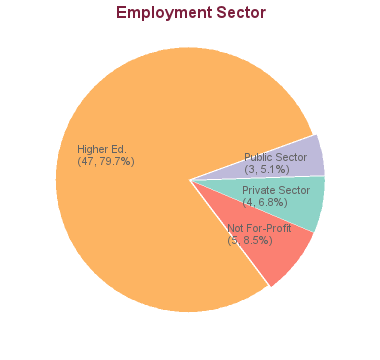
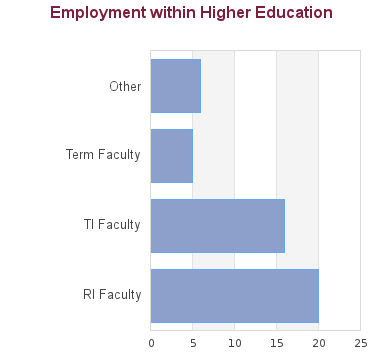
68 students graduated between 2005 and 2013: 3 are in non-salaried situations; for 6 we have no data (based on research conducted between Feb-May 2016). For the remaining 59 graduates:
University of British Columbia (11)
Royal Roads University (2)
Capilano University (2)
Concordia University (2)
Lakehead University (2)
University of Alberta (2)
University of Wollongong
Mount Saint Vincent University
Columbus State University
Thompson Rivers University
BC School District
Alpha Secondary School
Museum of Vancouver
Government of Lesotho
TEC
Community Association for Lasting Success
Da Vinci Science Center
HR MacMillan Space Centre
Wells Fargo
Pythagoras Academy
Teacher (2)
President
Community Artist and Contract Researcher
Teacher Principal
Senior Manager, Curatorial
VP
Science Education Manager
Personal Banker
High Commissioner to Canada
Head Start Early Education Coordinator
You may view the full report on career outcomes of UBC PhD graduates on outcomes.grad.ubc.ca.
These data represent historical employment information and do not guarantee future employment prospects for graduates of this program. They are for informational purposes only. Data were collected through either alumni surveys or internet research.
These statistics show data for the Doctor of Philosophy in Curriculum Studies (PhD). Data are separated for each degree program combination. You may view data for other degree options in the respective program profile.
| 2024 | 2023 | 2022 | 2021 | 2020 | |
|---|---|---|---|---|---|
| Applications | 68 | 71 | 68 | 60 | 60 |
| Offers | 11 | 8 | 10 | 11 | 13 |
| New Registrations | 9 | 7 | 7 | 9 | 10 |
| Total Enrolment | 64 | 65 | 68 | 71 | 74 |
Students in research-based programs usually require a faculty member to function as their thesis supervisor. Please follow the instructions provided by each program whether applicants should contact faculty members.
These videos contain some general advice from faculty across UBC on finding and reaching out to a supervisor. They are not program specific.
This list shows faculty members with full supervisory privileges who are affiliated with this program. It is not a comprehensive list of all potential supervisors as faculty from other programs or faculty members without full supervisory privileges can request approvals to supervise graduate students in this program.
| Year | Citation |
|---|---|
| 2025 | Schoolteachers have many overlapping, even conflicting, responsibilities, leaving them to navigate some way in between. Dr. Robertson studied how these tensions influence teachers’ curricular decision-making alongside students. He found a teacher’s individual judgment and style are key aspects of what we generally call ‘The Curriculum’. |
| 2025 | Dr. Iskander worked with trans and gender nonconforming preservice teachers to study normative gender expectations in Canadian teacher education programs. Their dissertation offered insight into how programs might better welcome gender diversity as well as what trans knowledge and experience might offer programs and the teaching profession. |
| 2025 | Dr. Athié Martínez studied how non-Indigenous teachers from the greater Vancouver area are integrating Indigenous perspectives and reconciliation acts in their classroom. Her research shares insights on teachers’ perspectives, recommendations and approaches to reconciliation education. |
| 2025 | As a scholar of gender and international studies in curriculum theory, Dr. Takemura studied shifts in Japanese men’s perceptions of motherhood after World War II, concluding with perspectives of mothers in contemporary Japanese society. Dr. Takemura showed that understanding the self as seen by their mothers is the basis for attaining this perspective. |
| 2025 | Dr. Royea explored elementary mathematics teacher candidates experiences participating in professional development focused on collaboratively planning, teaching, and revising learning situations. Findings reveal that teacher candidates discerned new relationships between theory and practice in ways that support professional learning. |
| 2024 | Dr. Morimoto created an arts-based study walking with 12 features in the Nitobe Memorial Garden. With the a/r/tographic proposition of art practice as research, the work lingered in conversations with the intellectual life history of Ted Aoki to speculate on the pedagogical potential of art and love for curriculum theory and art education research. |
| 2024 | Dr. Allen found that students hold nuanced perspectives about learning technical writing in computer science and that their experiences of this learning are influenced by their communities in various and complex ways. Her work may impact curricula and adds to the understanding of students' experiences and perspectives in learning communicative skills. |
| 2024 | Dr. Mosavarzadeh’s arts-based educational research investigates the interplay between Making and Place a/r/tographically. Rooted in the co-walking and co-making practices of four artist-researcher-teachers, the work invites a (re)imagination of artful and pedagogical possibilities for making one's place in the world. |
| 2024 | Dr. O’Sullivan explored how quality is experienced by youth in community music making and learning contexts in Ireland. She observed Positive Youth Development in action and generated new quality touchstones. Through evocative stories, this study communicates how experiences that promote freedom, friendship, and community are integral to quality. |
| 2024 | Dr. Baldus' research studies contribute to correspondence and art practices that acknowledge the tension between individual experience and that collective thinking which happens across different kinds of distance and variation. |
Curriculum Studies encompasses, but is not limited to, investigations into: teacher education, the social construction of knowledge, the curriculum as culturally and politically situated, contemporary curriculum and instructional discourses, and the role of curriculum and curricular reform in K-12 and other learning environments. Students learn about issues of planning and development, program implementation and evaluation, and pre-service and in-service teacher education. Inquiry in the field is multi-disciplinary and includes numerous perspectives and orientations such as: cultural studies, historical consciousness, post structuralism, feminism, multicultural education, semiotics, and critical theory.
Departments/Programs may update graduate degree program details through the Faculty & Staff portal. To update contact details for application inquiries, please use this form.