Lulu Pei
Doctor of Philosophy in Human Nutrition (PhD)
Efficacy and adverse side effects of two forms of iron in prenatal micronutrient supplements (EASE-Iron): A randomized controlled trial
Review details about the recently announced changes to study and work permits that apply to master’s and doctoral degree students. Read more
The graduate program in Human Nutrition offers opportunities for advanced study and original investigations in basic and applied human nutrition at both the master's and doctoral levels. The curriculum includes coursework and thesis research through laboratory or field work in a variety of areas relevant to human nutrition including nutrient metabolism, diet and disease, nutrition through the life cycle and nutrition behaviours.
Research projects also examine environmental, social, and individual determinants of food choices and eating patterns; this includes better understanding of socio-cultural effects on diet, and the impact living in "food deserts" can have on good health.
International nutrition projects in Cambodia, Zambia, Rwanda, and other countries seek to improve maternal, infant, and child nutrition.
Before you apply, please make sure you meet/exceed the admission requirements and most importantly have a supervisor confirmed.
The Faculty of Graduate and Postdoctoral Studies establishes the minimum admission requirements common to all applicants, usually a minimum overall average in the B+ range (76% at UBC). The graduate program that you are applying to may have additional requirements. Please review the specific requirements for applicants with credentials from institutions in:
Each program may set higher academic minimum requirements. Please review the program website carefully to understand the program requirements. Meeting the minimum requirements does not guarantee admission as it is a competitive process.
Applicants from a university outside Canada in which English is not the primary language of instruction must provide results of an English language proficiency examination as part of their application. Tests must have been taken within the last 24 months at the time of submission of your application.
Minimum requirements for the two most common English language proficiency tests to apply to this program are listed below:
Overall score requirement: 90
Reading
22
Writing
21
Speaking
21
Listening
22
Overall score requirement: 6.5
Reading
6.0
Writing
6.0
Speaking
6.0
Listening
6.0
Some programs require additional test scores such as the Graduate Record Examination (GRE) or the Graduate Management Test (GMAT). The requirements for this program are:
The GRE is not required.
Applicants for the Ph.D. degree must ordinarily hold a First Class Master's degree in Nutrition with a standing of "A", and a Bachelor's degree with the above academic standing in Nutrition or a related science.
All applicants have to submit transcripts from all past post-secondary study. Document submission requirements depend on whether your institution of study is within Canada or outside of Canada.
Many programs require a statement of interest, sometimes called a "statement of intent", "description of research interests" or something similar.
Students in research-based programs usually require a faculty member to function as their thesis supervisor. Please follow the instructions provided by each program whether applicants should contact faculty members.
Permanent Residents of Canada must provide a clear photocopy of both sides of the Permanent Resident card.
All applicants must complete an online application form and pay the application fee to be considered for admission to UBC.
Clinical Nutrition Research Laboratory Our Clinical Nutrition Laboratory is equipped with an array of state-of-the-art analytical instruments, such as headspace GC-FID, GC-MS, HPLC-DAD, and UHPLC-DAD, etc.. Clinical Research Unit The Clinical Research Unit is comprised of a reception lounge, clinic rooms, a sample preparation area and a meeting room, that is equipped with an observation mirror and an audio/video system. The room is suitable for conducting small focus group meetings, and behavior and consumer studies. Vij’s Kitchen & Culinary Laboratory The Culinary Laboratory is equipped with numerous modern kitchen stations and a demonstration station. The on-site audiovisual system enables filming, videoconferencing, distance education, and live-webcasting. Sensory Laboratory The Sensory Laboratory consists of fourteen panelist booths complete with delivery windows and red lighting. The Sensory Lab is connected to the Culinary Laboratory for preparing food samples and a boardroom for panelist training. The Laboratory is ideal for teaching, research and commercial testing.
| Fees | Canadian Citizen / Permanent Resident / Refugee / Diplomat | International |
|---|---|---|
| Application Fee | $118.50 | $168.25 |
| Tuition * | ||
| Installments per year | 3 | 3 |
| Tuition per installment | $1,912.84 | $3,360.55 |
| Tuition per year (plus annual increase, usually 2%-5%) | $5,738.52 | $10,081.65 |
| Int. Tuition Award (ITA) per year (for eligible individuals) | $3,200.00 (-) | |
| Other Fees and Costs | ||
| Student Fees (yearly) | $1,169.35 (approx.) | |
| Costs of living | Estimate your costs of living with our interactive tool in order to start developing a financial plan for your graduate studies. | |
Applicants to UBC have access to a variety of funding options, including merit-based (i.e. based on your academic performance) and need-based (i.e. based on your financial situation) opportunities.
All full-time students in UBC-Vancouver PhD programs will be provided with a funding package of at least $40,000 for each of the first four years of their PhD from September 2026. The funding package may consist of any combination of internal or external awards, teaching-related work, research assistantships, and graduate academic assistantships. Please check with your prospective graduate program for specific details of the funding provided to its PhD students.
This results in a net balance (any funding provided to the student minus tuition and fees) mean of $40,144 and median of $37,156.
All applicants are encouraged to review the awards listing to identify potential opportunities to fund their graduate education. The database lists merit-based scholarships and awards and allows for filtering by various criteria, such as domestic vs. international or degree level.
Many professors are able to provide Research Assistantships (GRA) from their research grants to support full-time graduate students studying under their supervision. The duties constitute part of the student's graduate degree requirements. A Graduate Research Assistantship is considered a form of fellowship for a period of graduate study and is therefore not covered by a collective agreement. Stipends vary widely, and are dependent on the field of study and the type of research grant from which the assistantship is being funded.
Graduate programs may have Teaching Assistantships available for registered full-time graduate students. Full teaching assistantships involve 12 hours work per week in preparation, lecturing, or laboratory instruction although many graduate programs offer partial TA appointments at less than 12 hours per week. Teaching assistantship rates are set by collective bargaining between the University and the Teaching Assistants' Union.
Academic Assistantships are employment opportunities to perform work that is relevant to the university or to an individual faculty member, but not to support the student’s graduate research and thesis. Wages are considered regular earnings and when paid monthly, include vacation pay.
Canadian and US applicants may qualify for governmental loans to finance their studies. Please review eligibility and types of loans.
All students may be able to access private sector or bank loans.
UBC has working agreements with MPower Financing - an organization providing international students with no-cosigner, no-collateral education loans to study in Canada - and Windmill Microlending - an organization providing loans to skilled immigrants.
Many foreign governments provide support to their citizens in pursuing education abroad. International applicants should check the various governmental resources in their home country, such as the Department of Education, for available scholarships.
The possibility to pursue work to supplement income may depend on the demands the program has on students. It should be carefully weighed if work leads to prolonged program durations or whether work placements can be meaningfully embedded into a program.
International students enrolled as full-time students with a valid study permit can work on campus for unlimited hours and work off-campus for no more than 24 hours a week during academic sessions.
A good starting point to explore student jobs is the UBC Work Learn program or a Co-Op placement.
Students with taxable income in Canada may be able to claim federal or provincial tax credits.
Canadian residents with RRSP accounts may be able to use the Lifelong Learning Plan (LLP) which allows students to withdraw amounts from their registered retirement savings plan (RRSPs) to finance full-time training or education for themselves or their partner.
Please review Filing taxes in Canada on the student services website for more information.
Applicants have access to the cost estimator to develop a financial plan that takes into account various income sources and expenses.
8 students graduated between 2005 and 2013. Of these, career information was obtained for 8 alumni (based on research conducted between Feb-May 2016):
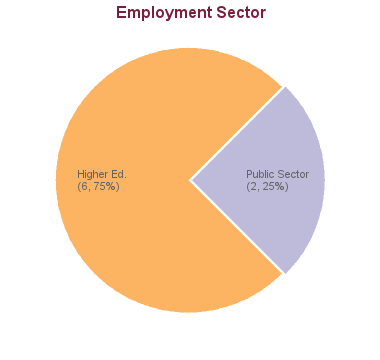
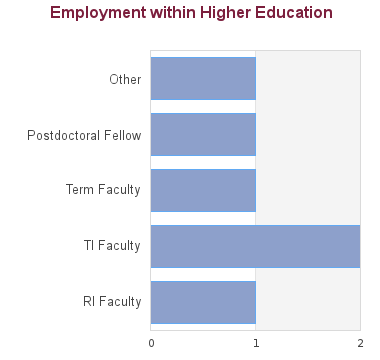
Graduates of our program have pursued academic positions at universities or colleges, consulting, or careers in health-related fields including medicine, dentistry, and others. Those who were registered dietitians before pursuing graduate study have gone on to senior clinical or administrative positions.
These statistics show data for the Doctor of Philosophy in Human Nutrition (PhD). Data are separated for each degree program combination. You may view data for other degree options in the respective program profile.
| 2024 | 2023 | 2022 | 2021 | 2020 | |
|---|---|---|---|---|---|
| Applications | 7 | 8 | 11 | 9 | 6 |
| Offers | 1 | 3 | 7 | 3 | 2 |
| New Registrations | 1 | 3 | 6 | 2 | 2 |
| Total Enrolment | 13 | 13 | 12 | 10 | 7 |
Students in research-based programs usually require a faculty member to function as their thesis supervisor. Please follow the instructions provided by each program whether applicants should contact faculty members.
These videos contain some general advice from faculty across UBC on finding and reaching out to a supervisor. They are not program specific.
This list shows faculty members with full supervisory privileges who are affiliated with this program. It is not a comprehensive list of all potential supervisors as faculty from other programs or faculty members without full supervisory privileges can request approvals to supervise graduate students in this program.
| Year | Citation |
|---|---|
| 2024 | Dr. Mozaffari examined the impact of diet diversity on type 2 diabetes. She showed that a diet diverse in five food groups, and a variety of vegetables and plant protein sources, may reduce the risk of type 2 diabetes. These findings will inform the revision of some dietary guidelines, which currently advocate for a diet limited to only three food groups. |
| 2023 | Dr. Cochrane studied natural vs synthetic folate supplementation during pregnancy. Her results showed that maternal folate status can be maintained by using either of the two supplements, but that human milk composition is affected. These findings will inform optimal folate supplementation practices during pregnancy for healthy starts in life. |
| 2023 | Dr. Williams examined the effectiveness of folic acid supplementation in children with sickle cell disease, an inherited blood disorder. The findings from his clinical trial provide evidence to inform nutritional management and supplementation practices in Canadian children living with this disease |
| 2022 | Dr. Turki used novel stable-isotope-based techniques to evaluate new dietary therapies for people with inborn errors of metabolism such as modified cornstarch in glycogen storage disease type I, and glycomacropeptide in phenylketonuria. The results of the series of studies will contribute to improving nutritional management in this population. |
| 2022 | Dr. Caballero measured how much lysine children use when they eat different plant-based foods, such as rice, oats and corn. Her work will help develop dietary guidelines for children that consume a predominantly plant-based diet. These guidelines will ensure they meet their lysine requirement, which is important for adequate growth and development. |
| 2020 | Dr. Mujica Coopman investigated the relationship of combined B vitamin and related nutrients with offspring birth size and fetal growth programming. Her findings suggest that vitamin B12 characterized maternal B vitamin and nutrient-related patterns and may play a key role in fetal growth and development. |
| 2020 | Dr. Beetch studied how natural compounds derived from diet, namely a class of polyphenols found in grapes and blueberries, can reverse aberrant DNA methylation patterns that underlie cancer. Her findings show that these compounds exert anti-cancer effects through epigenetic gene regulation, which can be used in cancer prevention and therapy. |
| 2018 | Drawing from national data, Dr. Tugault-Lafle characterised the determinants of diet quality among Canadian children on school days and how diet quality has changed from 2004 to 2015. These findings provide evidence to inform policy debates about the potential roles schools could play to influence the diet of Canadian children. |
| 2018 | Dr. Wiedeman focused on the essential dietary nutrient choline. She examined the association between choline intake and plasma levels at different stages of the life cycle. Her findings contribute to our knowledge about human choline nutrition and suggest that current dietary recommendations may be overestimated for infants. |
| 2017 | Vitamin B12 is an important nutrient for healthy growth and brain development, especially during pregnancy and infancy. Dr. Schroder developed a novel method for convenient and minimally invasive diagnosis of vitamin B12 deficiency. This method has been clinically translated and used in newborns here in Vancouver as well as in field studies in Indonesia. |
Human nutrition covers areas such as nutrient metabolism, diet and disease, nutrition through the life cycle, and nutrition behaviours.
Departments/Programs may update graduate degree program details through the Faculty & Staff portal. To update contact details for application inquiries, please use this form.