Tanzoom Ahmed
Doctor of Philosophy in Asian Studies (PhD)
Understanding Muslim Women in urban marginalized spaces of South Asia
Review details about the recently announced changes to study and work permits that apply to master’s and doctoral degree students. Read more
UBC's Asian Studies Department is the flagship Asian Studies department in Canada and is widely acknowledged as one of the finest in North America. The Department awards a PhD in Asian Studies to students working in a variety of regions and disciplines.
The department boasts over 20 graduate faculty, as well as a many tenure-track instructors and lecturers with wide-ranging expertise. Our more than 60 graduate students specialize in Chinese, Japanese, Korean, and South Asian Studies and craft individual programs within and across various humanities disciplines, including linguistics, literary study, history, philosophy, religious studies, and popular and visual culture. The Department offers instruction in the following languages: Cantonese, Modern and Classical Chinese, Hindi/Urdu, Modern and Classical Japanese, Korean, Persian, Punjabi, and Sanskrit.
The department is a hub for research activities related to Asia, including large collaborative projects, multiple lecture series and workshops, and professional development opportunities, which provide students ample opportunities to develop their expertise, pursue their interests, and develop professional connections with scholars from around the world. It also regularly hosts postdoctoral fellows and visiting scholars. In addition to the guaranteed four years of funding to all PhD students, the program offers a range of funding opportunities and support for research activities.
In addition to our strengths in language and literary studies, the Asian Studies Department stands out for the geographic and disciplinary breadth of its faculty. It offers a range of coursework, from specialized research seminars to comparative Pan-Asian, methodological and professional development courses, drawing on the diversity of faculty and student specializations.
The UBC Library is the second-largest research library in Canada and the Asian Library boasts one of the finest Asian collections in North America, with a particular strength in East Asian materials.
The Faculty of Graduate and Postdoctoral Studies establishes the minimum admission requirements common to all applicants, usually a minimum overall average in the B+ range (76% at UBC). The graduate program that you are applying to may have additional requirements. Please review the specific requirements for applicants with credentials from institutions in:
Each program may set higher academic minimum requirements. Please review the program website carefully to understand the program requirements. Meeting the minimum requirements does not guarantee admission as it is a competitive process.
Applicants from a university outside Canada in which English is not the primary language of instruction must provide results of an English language proficiency examination as part of their application. Tests must have been taken within the last 24 months at the time of submission of your application.
Minimum requirements for the two most common English language proficiency tests to apply to this program are listed below:
Overall score requirement: 90
Reading
22
Writing
21
Speaking
21
Listening
22
Overall score requirement: 6.5
Reading
6.0
Writing
6.0
Speaking
6.0
Listening
6.0
Some programs require additional test scores such as the Graduate Record Examination (GRE) or the Graduate Management Test (GMAT). The requirements for this program are:
The GRE is not required.
All applicants have to submit transcripts from all past post-secondary study. Document submission requirements depend on whether your institution of study is within Canada or outside of Canada.
Many programs require a statement of interest, sometimes called a "statement of intent", "description of research interests" or something similar.
Students in research-based programs usually require a faculty member to function as their thesis supervisor. Please follow the instructions provided by each program whether applicants should contact faculty members.
Permanent Residents of Canada must provide a clear photocopy of both sides of the Permanent Resident card.
All applicants must complete an online application form and pay the application fee to be considered for admission to UBC.
| Fees | Canadian Citizen / Permanent Resident / Refugee / Diplomat | International |
|---|---|---|
| Application Fee | $118.50 | $168.25 |
| Tuition * | ||
| Installments per year | 3 | 3 |
| Tuition per installment | $1,912.84 | $3,360.55 |
| Tuition per year (plus annual increase, usually 2%-5%) | $5,738.52 | $10,081.65 |
| Int. Tuition Award (ITA) per year (if eligible) | $3,200.00 (-) | |
| Other Fees and Costs | ||
| Student Fees (yearly) | $1,169.35 (approx.) | |
| Costs of living | Estimate your costs of living with our interactive tool in order to start developing a financial plan for your graduate studies. | |
Applicants to UBC have access to a variety of funding options, including merit-based (i.e. based on your academic performance) and need-based (i.e. based on your financial situation) opportunities.
All full-time students in UBC-Vancouver PhD programs will be provided with a funding package of at least $40,000 for each of the first four years of their PhD from September 2026. The funding package may consist of any combination of internal or external awards, teaching-related work, research assistantships, and graduate academic assistantships. Please check with your prospective graduate program for specific details of the funding provided to its PhD students.
This results in a net balance (any funding provided to the student minus tuition and fees) mean of $35,319 and median of $34,239.
All applicants are encouraged to review the awards listing to identify potential opportunities to fund their graduate education. The database lists merit-based scholarships and awards and allows for filtering by various criteria, such as domestic vs. international or degree level.
Many professors are able to provide Research Assistantships (GRA) from their research grants to support full-time graduate students studying under their supervision. The duties constitute part of the student's graduate degree requirements. A Graduate Research Assistantship is considered a form of fellowship for a period of graduate study and is therefore not covered by a collective agreement. Stipends vary widely, and are dependent on the field of study and the type of research grant from which the assistantship is being funded.
Graduate programs may have Teaching Assistantships available for registered full-time graduate students. Full teaching assistantships involve 12 hours work per week in preparation, lecturing, or laboratory instruction although many graduate programs offer partial TA appointments at less than 12 hours per week. Teaching assistantship rates are set by collective bargaining between the University and the Teaching Assistants' Union.
Academic Assistantships are employment opportunities to perform work that is relevant to the university or to an individual faculty member, but not to support the student’s graduate research and thesis. Wages are considered regular earnings and when paid monthly, include vacation pay.
Canadian and US applicants may qualify for governmental loans to finance their studies. Please review eligibility and types of loans.
All students may be able to access private sector or bank loans.
UBC has working agreements with MPower Financing - an organization providing international students with no-cosigner, no-collateral education loans to study in Canada - and Windmill Microlending - an organization providing loans to skilled immigrants.
Many foreign governments provide support to their citizens in pursuing education abroad. International applicants should check the various governmental resources in their home country, such as the Department of Education, for available scholarships.
The possibility to pursue work to supplement income may depend on the demands the program has on students. It should be carefully weighed if work leads to prolonged program durations or whether work placements can be meaningfully embedded into a program.
International students enrolled as full-time students with a valid study permit can work on campus for unlimited hours and work off-campus for no more than 24 hours a week during academic sessions.
A good starting point to explore student jobs is the UBC Work Learn program or a Co-Op placement.
Students with taxable income in Canada may be able to claim federal or provincial tax credits.
Canadian residents with RRSP accounts may be able to use the Lifelong Learning Plan (LLP) which allows students to withdraw amounts from their registered retirement savings plan (RRSPs) to finance full-time training or education for themselves or their partner.
Please review Filing taxes in Canada on the student services website for more information.
Applicants have access to the cost estimator to develop a financial plan that takes into account various income sources and expenses.
30 students graduated between 2005 and 2013: 1 graduate is seeking employment; 1 is in a non-salaried situation; for 4 we have no data (based on research conducted between Feb-May 2016). For the remaining 24 graduates:
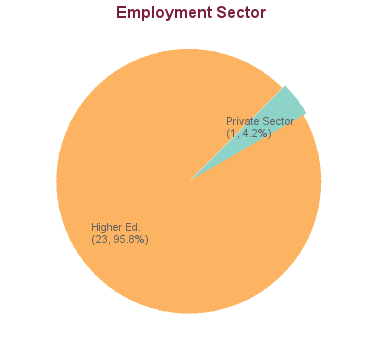
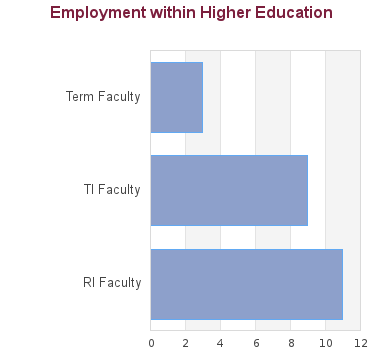
Recent PhDs in Asian Studies have landed postdoctoral fellowships and academic positions at institutions across the globe, including teaching positions at the Universities of Alberta, Calgary, Victoria, Lethbridge, and Winnipeg in Canada; University of Cincinnati, Harvard, Stanford, SUNY New Paltz, and the University of Montana, in the US; and York (UK), Ritsumeikan (Japan), and the University of Indonesia.
These statistics show data for the Doctor of Philosophy in Asian Studies (PhD). Data are separated for each degree program combination. You may view data for other degree options in the respective program profile.
| 2024 | 2023 | 2022 | 2021 | 2020 | |
|---|---|---|---|---|---|
| Applications | 57 | 83 | 57 | 52 | 55 |
| Offers | 3 | 4 | 7 | 0 | 11 |
| New Registrations | 2 | 3 | 4 | 0 | 5 |
| Total Enrolment | 29 | 33 | 36 | 35 | 35 |
Students in research-based programs usually require a faculty member to function as their thesis supervisor. Please follow the instructions provided by each program whether applicants should contact faculty members.
These videos contain some general advice from faculty across UBC on finding and reaching out to a supervisor. They are not program specific.
This list shows faculty members with full supervisory privileges who are affiliated with this program. It is not a comprehensive list of all potential supervisors as faculty from other programs or faculty members without full supervisory privileges can request approvals to supervise graduate students in this program.
| Year | Citation |
|---|---|
| 2025 | Dr. Kim examined Korea’s military reform and exile policies from 1863 to 1894. He found that military service was viewed as a social disgrace and reforms remained deeply rooted in traditional values. His work challenges Eurocentric narratives of military history during this period. |
| 2024 | Dr. Eshghi Furuzawa analyzed Japanese short stories from the By Women, For Women R-18 Literary Prize. Through an examination of the historical role of governments, publishers and libraries in managing access to sexual writing, she argues that the prize stories represent a source of sexual knowledge and empowerment that challenge chastity ideals. |
| 2024 | Dr. Hanlon’s research investigated several poetry matches from tenth- to twelfth-century Japan. His research examined matches with clever riddles, sassy love poems, and political drama, provided insight into the history of Japanese poetic games, and included translations and explanations for 140 waka poems. |
| 2024 | Dr. Ze examined Sino-Korean relations in the late nineteenth century as seen through case studies involving Chinese merchants on the Korean peninsula. By analyzing a series of case studies, her research provided insights into the transition of regional order from a tributary system to the world order of international law in the late nineteenth century. |
| 2024 | Dr. Blum analyzed the transformation of plants into humans in premodern Japanese short fiction. She showed that plant characters offered religious and educational messages to readers and listeners while providing entertainment and the novelty of the supernatural.Her work provides new insights into the matrix of Buddhism and popular culture in that period. |
| 2024 | Dr. Sembi studied the Suraj Prakash (1843), a pivotal historical narrative on the lives of the Sikh Gurus. The study revealed how precolonial Sikh scholars were engaged with diverse transreligious philosophical and mythological currents, contributing to the understanding of Sikh history and its methods prior to colonial influence. |
| 2024 | Dr. Diwan studied how and why audiences in India watch video streaming media. Her work shows the role of factors like language, geolocation, fandom etc. in digital viewership practices. By theorizing this set of audience behavior, she developed the concept of the interactive viewer to advance the understanding of digital audiences in Media Studies. |
| 2023 | Dr. Takano explored how massive population movements around the turn of the fifteenth century influenced Chinese literature by analyzing the writings of Li Dongyang (1447-1516). He found that Li expressed a conflicted geographic identity as a descendant of migrants sandwiched between his ancestral hometown and his place of residence in Beijing. |
| 2023 | Dr. Liu has shown the poetics of pidgin in Chinese literature. She challenges the stigmas associated with this language, emphasizing its aesthetics that embrace ambiguities and invite diverse interpretations. Through pidgin, her study reconfigures understandings of transcultural interaction and bridges Sinophone and Anglophone literatures. |
| 2023 | Dr. Collins demonstrated how the Japanese new religion Shinnyo-en is shaped by sacred stories about its founders. He found that members form emotional bonds with one another, the founders, and the organization by intertwining the founders' narratives with their own lives and with elements of Japanese Buddhist ritual, objects, spaces, and art. |
Asian Studies encompasses Chinese, Japanese, Korean, East Asian Buddhism, and South Asian culture, including literature, visual and popular culture, linguistics, pre-modern history, religion, and philosophy.
Departments/Programs may update graduate degree program details through the Faculty & Staff portal. To update contact details for application inquiries, please use this form.