Makayla Freeman
Doctor of Philosophy in Counselling Psychology (PhD)
Supporting 2SLGBTQIA+ Parents: Exploring Preferences for Wellbeing and Parenting Programs
Review details about the recently announced changes to study and work permits that apply to master’s and doctoral degree students. Read more
The Counselling Psychology Program, in line with the mission of the research-intensive University of British Columbia, creates, advances and critically examines knowledge in counselling psychology, especially with respect to its validity, applicability, limits, and interface with other disciplines. In developing and applying pertinent and innovative research methodologies, the Counselling Psychology Program relies upon and builds qualitative and quantitative evidence to determine effective counselling interventions in educational, community, health, and occupational settings.
Our Doctoral Program is accredited by the Canadian Psychological Association and follows the scientist-practitioner model for the education of counselling psychologists: students receive a substantial education as both researchers and professional psychologists. Designed for those with relevant experience who want to gain doctoral level competence, this program enhances research, counselling theory, and counselling skills.
The Faculty of Graduate and Postdoctoral Studies establishes the minimum admission requirements common to all applicants, usually a minimum overall average in the B+ range (76% at UBC). The graduate program that you are applying to may have additional requirements. Please review the specific requirements for applicants with credentials from institutions in:
Each program may set higher academic minimum requirements. Please review the program website carefully to understand the program requirements. Meeting the minimum requirements does not guarantee admission as it is a competitive process.
Applicants from a university outside Canada in which English is not the primary language of instruction must provide results of an English language proficiency examination as part of their application. Tests must have been taken within the last 24 months at the time of submission of your application.
Minimum requirements for the two most common English language proficiency tests to apply to this program are listed below:
Overall score requirement: 90
Reading
22
Writing
22
Speaking
22
Listening
22
Overall score requirement: 6.5
Reading
6.0
Writing
6.0
Speaking
6.0
Listening
6.0
Some programs require additional test scores such as the Graduate Record Examination (GRE) or the Graduate Management Test (GMAT). The requirements for this program are:
The GRE is not required.
All applicants have to submit transcripts from all past post-secondary study. Document submission requirements depend on whether your institution of study is within Canada or outside of Canada.
Many programs require a statement of interest, sometimes called a "statement of intent", "description of research interests" or something similar.
Students in research-based programs usually require a faculty member to function as their thesis supervisor. Please follow the instructions provided by each program whether applicants should contact faculty members.
Permanent Residents of Canada must provide a clear photocopy of both sides of the Permanent Resident card.
All applicants must complete an online application form and pay the application fee to be considered for admission to UBC.
| Fees | Canadian Citizen / Permanent Resident / Refugee / Diplomat | International |
|---|---|---|
| Application Fee | $118.50 | $168.25 |
| Tuition * | ||
| Installments per year | 3 | 3 |
| Tuition per installment | $1,912.84 | $3,360.55 |
| Tuition per year (plus annual increase, usually 2%-5%) | $5,738.52 | $10,081.65 |
| Int. Tuition Award (ITA) per year (if eligible) | $3,200.00 (-) | |
| Other Fees and Costs | ||
| Student Fees (yearly) | $1,169.35 (approx.) | |
| Costs of living | Estimate your costs of living with our interactive tool in order to start developing a financial plan for your graduate studies. | |
Applicants to UBC have access to a variety of funding options, including merit-based (i.e. based on your academic performance) and need-based (i.e. based on your financial situation) opportunities.
All full-time students in UBC-Vancouver PhD programs will be provided with a funding package of at least $40,000 for each of the first four years of their PhD from September 2026. The funding package may consist of any combination of internal or external awards, teaching-related work, research assistantships, and graduate academic assistantships. Please check with your prospective graduate program for specific details of the funding provided to its PhD students.
This results in a net balance (any funding provided to the student minus tuition and fees) mean of $32,013 and median of $27,785.
All applicants are encouraged to review the awards listing to identify potential opportunities to fund their graduate education. The database lists merit-based scholarships and awards and allows for filtering by various criteria, such as domestic vs. international or degree level.
Many professors are able to provide Research Assistantships (GRA) from their research grants to support full-time graduate students studying under their supervision. The duties constitute part of the student's graduate degree requirements. A Graduate Research Assistantship is considered a form of fellowship for a period of graduate study and is therefore not covered by a collective agreement. Stipends vary widely, and are dependent on the field of study and the type of research grant from which the assistantship is being funded.
Graduate programs may have Teaching Assistantships available for registered full-time graduate students. Full teaching assistantships involve 12 hours work per week in preparation, lecturing, or laboratory instruction although many graduate programs offer partial TA appointments at less than 12 hours per week. Teaching assistantship rates are set by collective bargaining between the University and the Teaching Assistants' Union.
Academic Assistantships are employment opportunities to perform work that is relevant to the university or to an individual faculty member, but not to support the student’s graduate research and thesis. Wages are considered regular earnings and when paid monthly, include vacation pay.
Canadian and US applicants may qualify for governmental loans to finance their studies. Please review eligibility and types of loans.
All students may be able to access private sector or bank loans.
UBC has working agreements with MPower Financing - an organization providing international students with no-cosigner, no-collateral education loans to study in Canada - and Windmill Microlending - an organization providing loans to skilled immigrants.
Many foreign governments provide support to their citizens in pursuing education abroad. International applicants should check the various governmental resources in their home country, such as the Department of Education, for available scholarships.
The possibility to pursue work to supplement income may depend on the demands the program has on students. It should be carefully weighed if work leads to prolonged program durations or whether work placements can be meaningfully embedded into a program.
International students enrolled as full-time students with a valid study permit can work on campus for unlimited hours and work off-campus for no more than 24 hours a week during academic sessions.
A good starting point to explore student jobs is the UBC Work Learn program or a Co-Op placement.
Students with taxable income in Canada may be able to claim federal or provincial tax credits.
Canadian residents with RRSP accounts may be able to use the Lifelong Learning Plan (LLP) which allows students to withdraw amounts from their registered retirement savings plan (RRSPs) to finance full-time training or education for themselves or their partner.
Please review Filing taxes in Canada on the student services website for more information.
Applicants have access to the cost estimator to develop a financial plan that takes into account various income sources and expenses.
52 students graduated between 2005 and 2013. Of these, career information was obtained for 50 alumni (based on research conducted between Feb-May 2016):
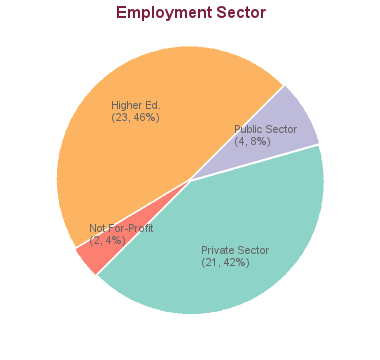
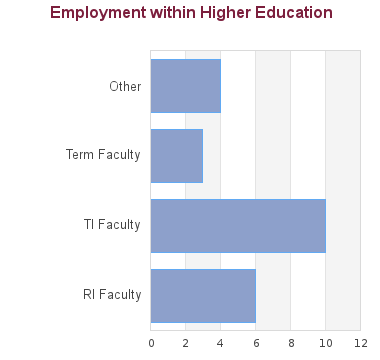
Students will be prepared for careers as researchers, practitioners, and educators in a wide variety of settings including academic, clinical, community, business, private practice, and research. Our graduates hold positions such as staff psychologist, research manager, professor, director, department head, clinical counsellor, vocational rehabilitation consultant, team leader, behavioural consultant, group facilitator, and psychoanalyst.
These statistics show data for the Doctor of Philosophy in Counselling Psychology (PhD). Data are separated for each degree program combination. You may view data for other degree options in the respective program profile.
| 2024 | 2023 | 2022 | 2021 | 2020 | |
|---|---|---|---|---|---|
| Applications | 18 | 13 | 21 | 17 | 19 |
| Offers | 1 | 3 | 2 | 3 | 4 |
| New Registrations | 1 | 2 | 2 | 3 | 4 |
| Total Enrolment | 25 | 31 | 32 | 32 | 35 |
Students in research-based programs usually require a faculty member to function as their thesis supervisor. Please follow the instructions provided by each program whether applicants should contact faculty members.
These videos contain some general advice from faculty across UBC on finding and reaching out to a supervisor. They are not program specific.
This list shows faculty members with full supervisory privileges who are affiliated with this program. It is not a comprehensive list of all potential supervisors as faculty from other programs or faculty members without full supervisory privileges can request approvals to supervise graduate students in this program.
| Year | Citation |
|---|---|
| 2025 | Syler compared two interventions to help individuals maintain non-problematic alcohol use. The career-focused intervention had greater outcomes than the identity-focused intervention but his research also highlighted the possibility that individuals’ needs change throughout their recoveries. |
| 2025 | Dr. MacKenzie studied caregiver joint goal-directed action in adolescent anorexia recovery using the Action-Project Method with caregivers worldwide during the COVID-19 pandemic. Her research explored how caregivers approach meal support to foster recovery and connection during family-based treatment. These findings support caregivers, clinicians, and recovering adolescents. |
| 2025 | Dr. Bennett explored how trauma therapists who become vicariously resilient through their work with clients with trauma experience both professional and personal growth. Incorporating vicarious resilience into training and supervision models for therapists has the potential to mitigate the risks for experiencing negative impacts of trauma work. |
| 2025 | Dr. Yu studied parents’ process of seeking mental health services for their children. She developed a theory of help-seeking for parents of children with anxiety. Her results may help to inform policymakers and practitioners by highlighting the role of parental advocacy and mental health literacy when navigating the mental health system. |
| 2024 | Dr. Della-Rossa's research investigated the experiences of middle-aged immigrant women who changed their careers later in life. She found that help and support from various sources and personal characteristics were instrumental in successful transitions. Her findings contribute to the body of knowledge about immigration, adaptation, women in career issues, and career transitions. |
| 2024 | How do adoptees make meaning of their sense of self in relation to what they know about their families of origin? Dr. Bork’s research indicates that adoptees are informed by the intergenerational knowledge of the particular family line they feel most embraced by. Her research helps us understand how to better support adoptees and their families. |
| 2024 | Dr. Bridger interviewed Hard of Hearing (HoH) students transitioning to their neighbourhood high school. She created a theory of the transition that highlights parallels with typically hearing peers, but also amplifies barriers faced by HoH students. The theory informs HoH teens and teachers of HoH students' struggles and ways to support them. |
| 2024 | Dr. Baugh studied the barriers and facilitators of coping among women veteran survivors of military sexual trauma. Illustrated in the women veterans' narratives is the importance of safety and support to move beyond survival strategies and towards meaningful facilitators of coping, and the crucial need for systemic reformation in military culture. |
| 2024 | Dr. Heaslip examined the unsolicited help receiving experiences of persons with visual impairments, targeting what is and isn't helpful during these interactions. The prominent themes identified were consent, assumptions, courtesy, consideration and respect. Findings were used to generate recommendations for navigating these complex interactions. |
| 2023 | Dr. Gendron explored gay, bisexual, and queer men's narrative positioning in sexual stories using an innovative reflective storytelling method. Focusing on perceived possibilities and pleasures in sex, Dr. Gendron's research offers a critical response to existing frameworks that regulate sex between men and socialize men away from connection. |
Programs of research reflect the core values and foci of the discipline of Counselling Psychology: career development, health and wellness, indigenous healing, gender and cultural diversity, disability, and social justice issues. Faculty members are involved in a wide range of research activities including intercultural counselling, First Nations counselling, career development and counselling, stress and coping, sexuality and reproductive health, disabilities, trauma, working with families and children in school settings, prevention of anxiety disorders, and empirically supported approaches utilizing both quantitative and qualitative methodologies.
Departments/Programs may update graduate degree program details through the Faculty & Staff portal. To update contact details for application inquiries, please use this form.