
Canadian Immigration Updates
Applicants to Master’s and Doctoral degrees are not affected by the recently announced cap on study permits. Review more details
Overview
The graduate program in Human Nutrition offers opportunities for advanced study and original investigations in basic and applied human nutrition at both the master's and doctoral levels. The curriculum includes coursework and thesis research through laboratory or field work in a variety of areas relevant to human nutrition including nutrient metabolism, diet and disease, nutrition through the life cycle and nutrition behaviours.
Research projects also examine environmental, social, and individual determinants of food choices and eating patterns; this includes better understanding of socio-cultural effects on diet, and the impact living in "food deserts" can have on good health.
International nutrition projects in Cambodia, Zambia, Rwanda, and other countries seek to improve maternal, infant, and child nutrition.

Quick Facts
Program Enquiries
Contact the program
Admission Information & Requirements
Program Instructions
Before you apply, please make sure you meet/exceed the admission requirements and most importantly have a supervisor confirmed.
1) Check Eligibility
Minimum Academic Requirements
The Faculty of Graduate and Postdoctoral Studies establishes the minimum admission requirements common to all applicants, usually a minimum overall average in the B+ range (76% at UBC). The graduate program that you are applying to may have additional requirements. Please review the specific requirements for applicants with credentials from institutions in:
Each program may set higher academic minimum requirements. Please review the program website carefully to understand the program requirements. Meeting the minimum requirements does not guarantee admission as it is a competitive process.
English Language Test
Applicants from a university outside Canada in which English is not the primary language of instruction must provide results of an English language proficiency examination as part of their application. Tests must have been taken within the last 24 months at the time of submission of your application.
Minimum requirements for the two most common English language proficiency tests to apply to this program are listed below:
TOEFL: Test of English as a Foreign Language - internet-based
Overall score requirement: 90
Reading
22
Writing
21
Speaking
21
Listening
22
IELTS: International English Language Testing System
Overall score requirement: 6.5
Reading
6.0
Writing
6.0
Speaking
6.0
Listening
6.0
Other Test Scores
Some programs require additional test scores such as the Graduate Record Examination (GRE) or the Graduate Management Test (GMAT). The requirements for this program are:
The GRE is not required.
Prior degree, course and other requirements
Prior Degree Requirements
Applicants for the Ph.D. degree must ordinarily hold a First Class Master's degree in Nutrition with a standing of "A", and a Bachelor's degree with the above academic standing in Nutrition or a related science.
2) Meet Deadlines
January 2025 Intake
Application Open Date
15 April 2024Canadian Applicants
International Applicants
May 2025 Intake
Application Open Date
15 July 2024Canadian Applicants
International Applicants
3) Prepare Application
Transcripts
All applicants have to submit transcripts from all past post-secondary study. Document submission requirements depend on whether your institution of study is within Canada or outside of Canada.
Letters of Reference
A minimum of three references are required for application to graduate programs at UBC. References should be requested from individuals who are prepared to provide a report on your academic ability and qualifications.
Statement of Interest
Many programs require a statement of interest, sometimes called a "statement of intent", "description of research interests" or something similar.
Supervision
Students in research-based programs usually require a faculty member to function as their thesis supervisor. Please follow the instructions provided by each program whether applicants should contact faculty members.
Instructions regarding thesis supervisor contact for Doctor of Philosophy in Human Nutrition (PhD)
Citizenship Verification
Permanent Residents of Canada must provide a clear photocopy of both sides of the Permanent Resident card.
4) Apply Online
All applicants must complete an online application form and pay the application fee to be considered for admission to UBC.
Research Information
Research Focus
Research projects examine environmental, social, and individual determinants of food choices and eating patterns; this includes better understanding of socio-cultural effects on diet, and the impact living in “food deserts” can have on good health. International nutrition projects in Cambodia, Zambia, Rwanda, and other countries seek to improve maternal, infant, and child nutrition.
Research Facilities
Clinical Nutrition Research Laboratory Our Clinical Nutrition Laboratory is equipped with an array of state-of-the-art analytical instruments, such as headspace GC-FID, GC-MS, HPLC-DAD, and UHPLC-DAD, etc.. Clinical Research Unit The Clinical Research Unit is comprised of a reception lounge, clinic rooms, a sample preparation area and a meeting room, that is equipped with an observation mirror and an audio/video system. The room is suitable for conducting small focus group meetings, and behavior and consumer studies. Vij’s Kitchen & Culinary Laboratory The Culinary Laboratory is equipped with numerous modern kitchen stations and a demonstration station. The on-site audiovisual system enables filming, videoconferencing, distance education, and live-webcasting. Sensory Laboratory The Sensory Laboratory consists of fourteen panelist booths complete with delivery windows and red lighting. The Sensory Lab is connected to the Culinary Laboratory for preparing food samples and a boardroom for panelist training. The Laboratory is ideal for teaching, research and commercial testing.
Tuition & Financial Support
Tuition
| Fees | Canadian Citizen / Permanent Resident / Refugee / Diplomat | International |
|---|---|---|
| Application Fee | $114.00 | $168.25 |
| Tuition * | ||
| Installments per year | 3 | 3 |
| Tuition per installment | $1,838.57 | $3,230.06 |
| Tuition per year (plus annual increase, usually 2%-5%) | $5,515.71 | $9,690.18 |
| Int. Tuition Award (ITA) per year (if eligible) | $3,200.00 (-) | |
| Other Fees and Costs | ||
| Student Fees (yearly) | $1,116.60 (approx.) | |
| Costs of living | Estimate your costs of living with our interactive tool in order to start developing a financial plan for your graduate studies. | |
All fees for the year are subject to adjustment and UBC reserves the right to change any fees without notice at any time, including tuition and student fees. Tuition fees are reviewed annually by the UBC Board of Governors. In recent years, tuition increases have been 2% for continuing domestic students and between 2% and 5% for continuing international students. New students may see higher increases in tuition. Admitted students who defer their admission are subject to the potentially higher tuition fees for incoming students effective at the later program start date. In case of a discrepancy between this webpage and the UBC Calendar, the UBC Calendar entry will be held to be correct.
Financial Support
Applicants to UBC have access to a variety of funding options, including merit-based (i.e. based on your academic performance) and need-based (i.e. based on your financial situation) opportunities.
Program Funding Packages
From September 2024 all full-time students in UBC-Vancouver PhD programs will be provided with a funding package of at least $24,000 for each of the first four years of their PhD. The funding package may consist of any combination of internal or external awards, teaching-related work, research assistantships, and graduate academic assistantships. Please note that many graduate programs provide funding packages that are substantially greater than $24,000 per year. Please check with your prospective graduate program for specific details of the funding provided to its PhD students.
Average Funding
- 8 students received Teaching Assistantships. Average TA funding based on 8 students was $5,150.
- 7 students received Research Assistantships. Average RA funding based on 7 students was $14,240.
- 1 student received Academic Assistantships valued at $3,208.
- 10 students received internal awards. Average internal award funding based on 10 students was $12,358.
- 5 students received external awards. Average external award funding based on 5 students was $25,667.
Review methodology
Scholarships & awards (merit-based funding)
All applicants are encouraged to review the awards listing to identify potential opportunities to fund their graduate education. The database lists merit-based scholarships and awards and allows for filtering by various criteria, such as domestic vs. international or degree level.
Graduate Research Assistantships (GRA)
Many professors are able to provide Research Assistantships (GRA) from their research grants to support full-time graduate students studying under their supervision. The duties constitute part of the student's graduate degree requirements. A Graduate Research Assistantship is considered a form of fellowship for a period of graduate study and is therefore not covered by a collective agreement. Stipends vary widely, and are dependent on the field of study and the type of research grant from which the assistantship is being funded.
Graduate Teaching Assistantships (GTA)
Graduate programs may have Teaching Assistantships available for registered full-time graduate students. Full teaching assistantships involve 12 hours work per week in preparation, lecturing, or laboratory instruction although many graduate programs offer partial TA appointments at less than 12 hours per week. Teaching assistantship rates are set by collective bargaining between the University and the Teaching Assistants' Union.
Graduate Academic Assistantships (GAA)
Academic Assistantships are employment opportunities to perform work that is relevant to the university or to an individual faculty member, but not to support the student’s graduate research and thesis. Wages are considered regular earnings and when paid monthly, include vacation pay.
Financial aid (need-based funding)
Canadian and US applicants may qualify for governmental loans to finance their studies. Please review eligibility and types of loans.
All students may be able to access private sector or bank loans.
Foreign government scholarships
Many foreign governments provide support to their citizens in pursuing education abroad. International applicants should check the various governmental resources in their home country, such as the Department of Education, for available scholarships.
Working while studying
The possibility to pursue work to supplement income may depend on the demands the program has on students. It should be carefully weighed if work leads to prolonged program durations or whether work placements can be meaningfully embedded into a program.
International students enrolled as full-time students with a valid study permit can work on campus for unlimited hours and work off-campus for no more than 20 hours a week.
A good starting point to explore student jobs is the UBC Work Learn program or a Co-Op placement.
Tax credits and RRSP withdrawals
Students with taxable income in Canada may be able to claim federal or provincial tax credits.
Canadian residents with RRSP accounts may be able to use the Lifelong Learning Plan (LLP) which allows students to withdraw amounts from their registered retirement savings plan (RRSPs) to finance full-time training or education for themselves or their partner.
Please review Filing taxes in Canada on the student services website for more information.
Cost Estimator
Applicants have access to the cost estimator to develop a financial plan that takes into account various income sources and expenses.
Career Outcomes
8 students graduated between 2005 and 2013. Of these, career information was obtained for 8 alumni (based on research conducted between Feb-May 2016):
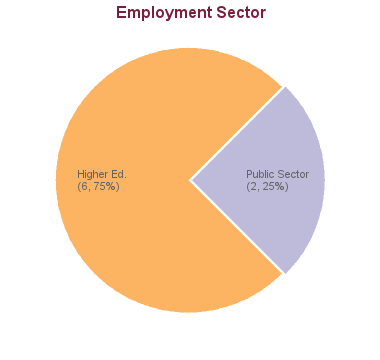
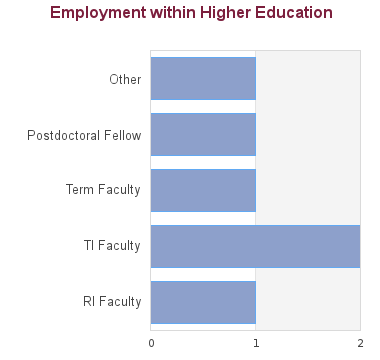
RI (Research-Intensive) Faculty: typically tenure-track faculty positions (equivalent of the North American Assistant Professor, Associate Professor, and Professor positions) in PhD-granting institutions
TI (Teaching-Intensive) Faculty: typically full-time faculty positions in colleges or in institutions not granting PhDs, and teaching faculty at PhD-granting institutions
Term Faculty: faculty in term appointments (e.g. sessional lecturers, visiting assistant professors, etc.)
Sample Employers in Higher Education
University of British Columbia (4)University of Victoria
Trinity Western University
Sample Employers Outside Higher Education
Centre for Health Evaluation & Outcome SciencesRoss Memorial Hospital
Sample Job Titles Outside Higher Education
Programme Evaluation LeadDietitian
PhD Career Outcome Survey
You may view the full report on career outcomes of UBC PhD graduates on outcomes.grad.ubc.ca.Disclaimer
These data represent historical employment information and do not guarantee future employment prospects for graduates of this program. They are for informational purposes only. Data were collected through either alumni surveys or internet research.Enrolment, Duration & Other Stats
These statistics show data for the Doctor of Philosophy in Human Nutrition (PhD). Data are separated for each degree program combination. You may view data for other degree options in the respective program profile.
ENROLMENT DATA
| 2023 | 2022 | 2021 | 2020 | 2019 | |
|---|---|---|---|---|---|
| Applications | 8 | 11 | 9 | 6 | 9 |
| Offers | 3 | 7 | 3 | 2 | 3 |
| New Registrations | 3 | 6 | 2 | 2 | 2 |
| Total Enrolment | 13 | 12 | 10 | 7 | 8 |
Completion Rates & Times
Disclaimer
Research Supervisors
Supervision
Students in research-based programs usually require a faculty member to function as their thesis supervisor. Please follow the instructions provided by each program whether applicants should contact faculty members.
Instructions regarding thesis supervisor contact for Doctor of Philosophy in Human Nutrition (PhD)
Advice and insights from UBC Faculty on reaching out to supervisors
These videos contain some general advice from faculty across UBC on finding and reaching out to a supervisor. They are not program specific.



Doctoral Citations
| Year | Citation |
|---|---|
| 2016 | Dr. Whitfield conducted her research in rural Cambodia, where infantile beriberi, a fatal disease in breastfed babies, is common. She showed that mothers consuming fish sauce with added vitamin B1 produced breast milk with higher B1 content, improving the status of their babies. This fish sauce could save babies lives throughout Southeast Asia. |
| 2015 | Dr. Mulder studied the role of dietary fats during early brain development. She identified that some women in Vancouver had omega-3 fatty acid deficiency, and that their babies were more likely to have slower development. Although the long-term effects are unclear, her work improves our understanding of nutritional needs in the developing brain. |
| 2011 | Dr. Novak combined basic science and clinical studies to demonstrate that the type of fat a mother consumes during pregnancy and lactation plays a key role in regulating infant liver metabolism. Her research opened a new field to consider the impact of essential fatty acid nutrition for early infant liver development. |
| 2011 | Dr. Mróz explored dietary perceptions and practices of men with prostate cancer and their wives. He found that although masculine food ideals shaped men's diets, complex couple dynamics were also implicated. His research showed that illuminating gender relations can help us better understand men's food and self-health practices. |
| 2010 | Dr. Hammond's research engaged lay women and dietitians in a collaborative participatory process to develop nutrition education resources. The research identified multiple benefits and specific challenges in applying community-based participatory processes to professional dietetic practice-based activities. |
| 2010 | Dr. Bedford explored whether negative eating/body attitudes are associated with detrimental health outcomes in young women. She examined relationships between eating/body attitudes, the stress hormone cortisol, blood pressure, menstrual cycle disturbances and bone density over two years. She also validated a method for long-term monitoring of menstrual cycle characteristics. |
Pages
Sample Thesis Submissions
Further Information
Specialization
Human nutrition covers areas such as nutrient metabolism, diet and disease, nutrition through the life cycle, and nutrition behaviours.
Program Website
Faculty Overview
Academic Unit
Program Identifier
Classification
January 2025 Intake
May 2025 Intake
Program Enquiries
Contact the program
Departments/Programs may update graduate degree program details through the Faculty & Staff portal. To update contact details for application inquiries, please use this form.

Why should you choose UBC?
From academic excellence and modern facilities to our diverse degree program listings to being named one of the “most innovative universities” by Reuters in 2019, UBC has a lot to offer.