
Ashwani Kumar
Job Title
Associate Professor
Employer
Mount Saint Vincent University

Review details about the recently announced changes to study and work permits that apply to master’s and doctoral degree students. Read more
Graduate programs in the field of Curriculum Studies encompass, but are not limited to, investigations into: teacher education, the social construction of knowledge, the curriculum as culturally and politically situated, contemporary curriculum and instructional discourses, and the role of curriculum and curricular reform in K-12 and other learning environments. Students learn about issues of planning and development, program implementation and evaluation, and pre-service and in-service teacher education. Inquiry in the field is multi-disciplinary and includes numerous perspectives and orientations such as: cultural studies, historical consciousness, post structuralism, feminism, multicultural education, semiotics, and critical theory.
The Faculty of Graduate and Postdoctoral Studies establishes the minimum admission requirements common to all applicants, usually a minimum overall average in the B+ range (76% at UBC). The graduate program that you are applying to may have additional requirements. Please review the specific requirements for applicants with credentials from institutions in:
Each program may set higher academic minimum requirements. Please review the program website carefully to understand the program requirements. Meeting the minimum requirements does not guarantee admission as it is a competitive process.
Applicants from a university outside Canada in which English is not the primary language of instruction must provide results of an English language proficiency examination as part of their application. Tests must have been taken within the last 24 months at the time of submission of your application.
Minimum requirements for the two most common English language proficiency tests to apply to this program are listed below:
Overall score requirement: 92
Reading
22
Writing
22
Speaking
22
Listening
22
Overall score requirement: 6.5
Reading
6.0
Writing
6.0
Speaking
6.0
Listening
6.0
Some programs require additional test scores such as the Graduate Record Examination (GRE) or the Graduate Management Test (GMAT). The requirements for this program are:
The GRE is not required.
A Master's degree with high standing in a relevant educational discipline.
A letter of intent describing the focus of the proposed research and a sample of work demonstrating scholarly writing,
All applicants have to submit transcripts from all past post-secondary study. Document submission requirements depend on whether your institution of study is within Canada or outside of Canada.
A minimum of two references are required for application to graduate programs at UBC. Each graduate program determines the type of reference (e.g. academic, professional) and number of references they require which can range from 2 to 4. References should be requested from individuals who are prepared to provide a report on your qualifications for the program.
Many programs require a statement of interest, sometimes called a "statement of intent", "description of research interests" or something similar.
Students in research-based programs usually require a faculty member to function as their thesis supervisor. Please follow the instructions provided by each program whether applicants should contact faculty members.
Permanent Residents of Canada must provide a clear photocopy of both sides of the Permanent Resident card.
All applicants must complete an online application form and pay the application fee to be considered for admission to UBC.
| Fees | Canadian Citizen / Permanent Resident / Refugee / Diplomat | International |
|---|---|---|
| Application Fee | $116.25 | $168.25 |
| Tuition * | ||
| Installments per year | 3 | 3 |
| Tuition per installment | $1,875.34 | $3,294.66 |
| Tuition per year (plus annual increase, usually 2%-5%) | $5,626.02 | $9,883.98 |
| Int. Tuition Award (ITA) per year (if eligible) | $3,200.00 (-) | |
| Other Fees and Costs | ||
| Student Fees (yearly) | $1,144.10 (approx.) | |
| Costs of living | Estimate your costs of living with our interactive tool in order to start developing a financial plan for your graduate studies. | |
Applicants to UBC have access to a variety of funding options, including merit-based (i.e. based on your academic performance) and need-based (i.e. based on your financial situation) opportunities.
From September 2024 all full-time students in UBC-Vancouver PhD programs will be provided with a funding package of at least $24,000 for each of the first four years of their PhD. The funding package may consist of any combination of internal or external awards, teaching-related work, research assistantships, and graduate academic assistantships. Please note that many graduate programs provide funding packages that are substantially greater than $24,000 per year. Please check with your prospective graduate program for specific details of the funding provided to its PhD students.
This results in a net balance (any funding provided to the student minus tuition and fees) mean of $31,881 and median of $24,736.
All applicants are encouraged to review the awards listing to identify potential opportunities to fund their graduate education. The database lists merit-based scholarships and awards and allows for filtering by various criteria, such as domestic vs. international or degree level.
Many professors are able to provide Research Assistantships (GRA) from their research grants to support full-time graduate students studying under their supervision. The duties constitute part of the student's graduate degree requirements. A Graduate Research Assistantship is considered a form of fellowship for a period of graduate study and is therefore not covered by a collective agreement. Stipends vary widely, and are dependent on the field of study and the type of research grant from which the assistantship is being funded.
Graduate programs may have Teaching Assistantships available for registered full-time graduate students. Full teaching assistantships involve 12 hours work per week in preparation, lecturing, or laboratory instruction although many graduate programs offer partial TA appointments at less than 12 hours per week. Teaching assistantship rates are set by collective bargaining between the University and the Teaching Assistants' Union.
Academic Assistantships are employment opportunities to perform work that is relevant to the university or to an individual faculty member, but not to support the student’s graduate research and thesis. Wages are considered regular earnings and when paid monthly, include vacation pay.
Canadian and US applicants may qualify for governmental loans to finance their studies. Please review eligibility and types of loans.
All students may be able to access private sector or bank loans.
Many foreign governments provide support to their citizens in pursuing education abroad. International applicants should check the various governmental resources in their home country, such as the Department of Education, for available scholarships.
The possibility to pursue work to supplement income may depend on the demands the program has on students. It should be carefully weighed if work leads to prolonged program durations or whether work placements can be meaningfully embedded into a program.
International students enrolled as full-time students with a valid study permit can work on campus for unlimited hours and work off-campus for no more than 24 hours a week during academic sessions.
A good starting point to explore student jobs is the UBC Work Learn program or a Co-Op placement.
Students with taxable income in Canada may be able to claim federal or provincial tax credits.
Canadian residents with RRSP accounts may be able to use the Lifelong Learning Plan (LLP) which allows students to withdraw amounts from their registered retirement savings plan (RRSPs) to finance full-time training or education for themselves or their partner.
Please review Filing taxes in Canada on the student services website for more information.
Applicants have access to the cost estimator to develop a financial plan that takes into account various income sources and expenses.
68 students graduated between 2005 and 2013: 3 are in non-salaried situations; for 6 we have no data (based on research conducted between Feb-May 2016). For the remaining 59 graduates:
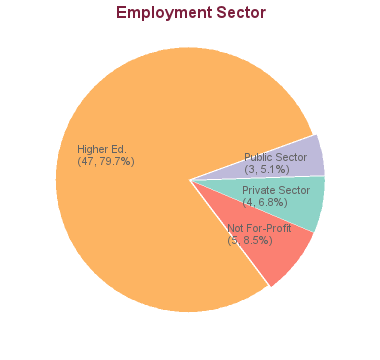
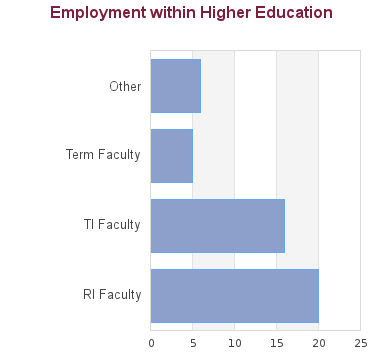
These statistics show data for the Doctor of Philosophy in Curriculum Studies (PhD). Data are separated for each degree program combination. You may view data for other degree options in the respective program profile.
| 2023 | 2022 | 2021 | 2020 | 2019 | |
|---|---|---|---|---|---|
| Applications | 71 | 68 | 60 | 60 | 52 |
| Offers | 8 | 10 | 11 | 13 | 13 |
| New Enrolment | 7 | 7 | 9 | 9 | 9 |
| Total Enrolment | 65 | 68 | 71 | 74 | 77 |
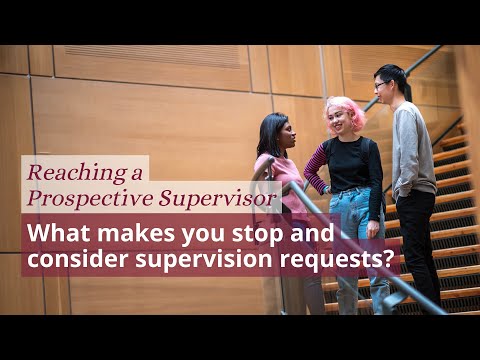
Students in research-based programs usually require a faculty member to function as their thesis supervisor. Please follow the instructions provided by each program whether applicants should contact faculty members.
These videos contain some general advice from faculty across UBC on finding and reaching out to a supervisor. They are not program specific.


| Year | Citation |
|---|---|
| 2009 | Dr. Peck researched the relationship between students' ethnic identities and their understanding of significance in Canadian history. She found that students'identities strongly influenced the narratives of Canadian history that they constructed. Her findings reveal the complex influences that identities have on understanding of history. |
| 2009 | Dr. Nicholson employed interactive inquiry activities to explore with youth the ways in which they experience dominant conceptions of what knowledge is and where knowledge comes from in their daily lives. Her research illustrates potential effects that implicitly-held conceptions of knowledge can have on education and research practices. |
| 2009 | Dr. Farzamian studied sociocultural and psychological factors that were part of immigrant executive?s cross-cultural adjustment experiences.This research assists us in understanding their challenges, identifies their coping strategies, and has important implications for counselling theory and practice. |
| 2009 | Dr. Vanston investigated tattooing practices of adolescent girls. She found that mothers and musicians were influential with girls' desire to get tattooed and with tattoo image and placement. Girls believed that tattoos reflected and communicated their experiences, interests, and relationships. |
| 2009 | Using post-structural feminist and Jungian psychoanalytic theories, Dr. Gregor demonstrates how women's experiences might be understood through close readings of night dreams and reading literary text as dream. This study contributes to imaginative learning and critical feminist understanding of the hidden trauma in women's lives. |
| 2009 | Dr. Nielsen studied the interface between what an individual understands about him or herself as a learner and a group context for learning in science classrooms. This research considered how individual metacognitive knowledge, skills and behaviors become consequential during group learning activity. |
| 2009 | Dr. Szabo explored the complexities between identities, contexts and reflective processes and how it is that inquiry into these spaces are lived. Through an interdisciplinary view of nursing education she focused on the form and structure of social texts and their potential to manifest a wholly other organic approach to curriculum and instruction. |
| 2008 | Dr Owuor investigated Kenyan teachers' perceptions of students' differences and how these influence curriculum implementation. Findings highlighted how social markers mask students' diversity.The study contributes to the literature on how teachers' practice influences educational success amidst challenges of poverty and HIV/AIDS in Africa. |
| 2008 | Dr. Mutonyi's case study investigated adolescent students' understanding of the relationship between Health Literacy, HIV/AIDS and Gender. The youth are a critical constituency of reform and it is important to engage them in issues that impact development including issues of health, literacy, HIV/AIDS and Gender. |
Curriculum Studies encompasses, but is not limited to, investigations into: teacher education, the social construction of knowledge, the curriculum as culturally and politically situated, contemporary curriculum and instructional discourses, and the role of curriculum and curricular reform in K-12 and other learning environments. Students learn about issues of planning and development, program implementation and evaluation, and pre-service and in-service teacher education. Inquiry in the field is multi-disciplinary and includes numerous perspectives and orientations such as: cultural studies, historical consciousness, post structuralism, feminism, multicultural education, semiotics, and critical theory.
Departments/Programs may update graduate degree program details through the Faculty & Staff portal. To update contact details for application inquiries, please use this form.
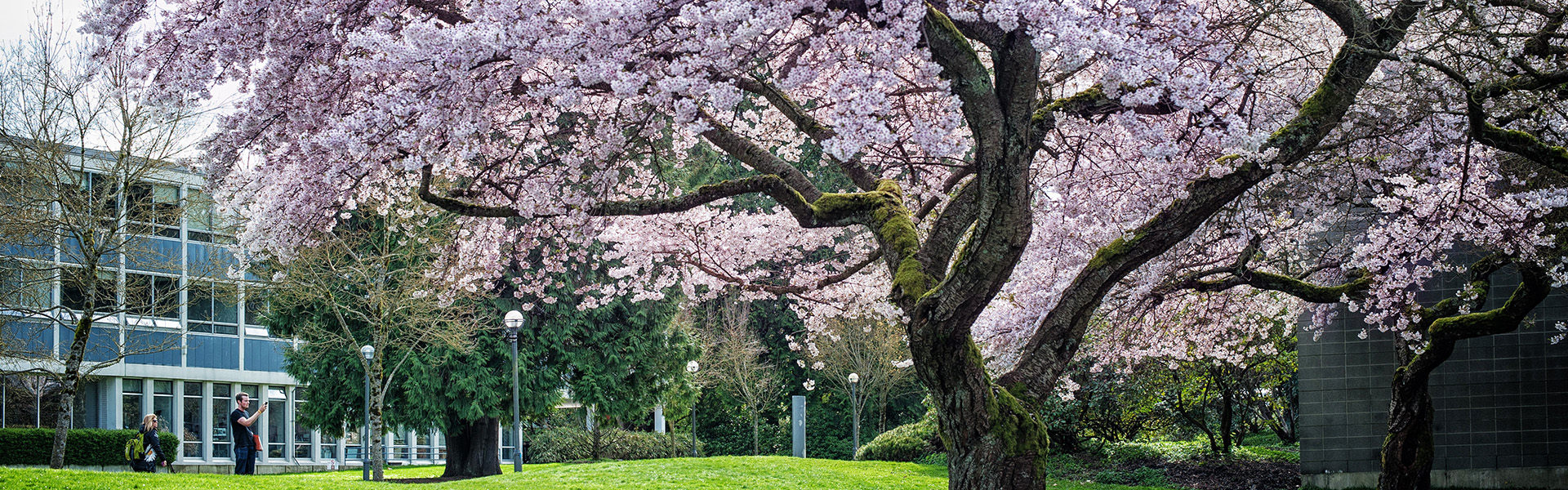
Great academic programs, great location: the distinct seasons and mild climate are among the reasons why graduate students choose to study here -- from the autumn leaves to cherry blossoms, witness the many colours Vancouver has to offer.