Peter Caravan
Job Title
Co-Director, Institute for Innovation in Imaging and Associate Professor of Radiology
Employer
Massachusetts General Hospital and Harvard Medical School
Review details about the recently announced changes to study and work permits that apply to master’s and doctoral degree students. Read more
In the Chemistry department Faculty, graduate students, postdoctoral fellows, undergraduates and staff members work cooperatively in a collegial environment to tackle some of the world's most pressing problems related to energy, health and sustainability.
Research areas in the department cover a wide range of subject matter, including applied chemistry, chemical synthesis, biological chemistry, environmental chemistry, chemical analysis, materials chemistry, chemical physics and theoretical chemistry.
NEW *Applications Close December 01 2025 for our top scholarships and to be eligible for an in-person visit of our department.
For all applicants, applications must be submitted by February 15 and all supporting documentation* received by March 15. International students are strongly encouraged to apply as early as possible to allow sufficient time for the study permit application process.
*Includes receipt of official English language test results sent directly from the testing center (if applicable)
Note: To be eligible for our top scholarships, domestic and international applications must be complete, including all letters of reference, by December 01 2025 11:59 pm Vancouver time (Pacific Time). Top applicants based in Canada or the U.S. may also be eligible for an in-person visit of our department if they complete their application by December 01 2025 11:59 pm Vancouver time (Pacific Time).
All students admitted into our graduate program will receive a competitive stipend. Tuition fees are paid for all qualifying PhD students, as part of complete multi-year funding packages that also include funding via Teaching Assistantships (TA) and Graduate Research Assistantships (GRA).
Outstanding facilities and resources accommodate more than 500 graduate students, postdoctoral fellows and faculty that call the Department of Chemistry home. The Department has one of the most comfortable and up-to-date research spaces in North America.
The Faculty of Graduate and Postdoctoral Studies establishes the minimum admission requirements common to all applicants, usually a minimum overall average in the B+ range (76% at UBC). The graduate program that you are applying to may have additional requirements. Please review the specific requirements for applicants with credentials from institutions in:
Each program may set higher academic minimum requirements. Please review the program website carefully to understand the program requirements. Meeting the minimum requirements does not guarantee admission as it is a competitive process.
Applicants from a university outside Canada in which English is not the primary language of instruction must provide results of an English language proficiency examination as part of their application. Tests must have been taken within the last 24 months at the time of submission of your application.
Minimum requirements for the two most common English language proficiency tests to apply to this program are listed below:
Overall score requirement: 92
Reading
23
Writing
22
Speaking
22
Listening
23
Overall score requirement: 6.5
Reading
6.0
Writing
6.0
Speaking
6.0
Listening
6.0
Some programs require additional test scores such as the Graduate Record Examination (GRE) or the Graduate Management Test (GMAT). The requirements for this program are:
The GRE is required by some applicants. Please check the program website.
All applicants have to submit transcripts from all past post-secondary study. Document submission requirements depend on whether your institution of study is within Canada or outside of Canada.
Many programs require a statement of interest, sometimes called a "statement of intent", "description of research interests" or something similar.
Students in research-based programs usually require a faculty member to function as their thesis supervisor. Please follow the instructions provided by each program whether applicants should contact faculty members.
Permanent Residents of Canada must provide a clear photocopy of both sides of the Permanent Resident card.
All applicants must complete an online application form and pay the application fee to be considered for admission to UBC.
Applicants who are interested in the production, preparation, and application of nuclear isotopes for science and medicine may consider the IsoSiM program. Applicants who are interested in quantum materials may consider the QuEST program.
| Fees | Canadian Citizen / Permanent Resident / Refugee / Diplomat | International |
|---|---|---|
| Application Fee | No application fee | $60.00 |
| Tuition * | ||
| Installments per year | 3 | 3 |
| Tuition per installment | $1,912.84 | $3,360.55 |
| Tuition per year (plus annual increase, usually 2%-5%) | $5,738.52 | $10,081.65 |
| Int. Tuition Award (ITA) per year (if eligible) | $3,200.00 (-) | |
| Other Fees and Costs | ||
| Student Fees (yearly) | $1,169.35 (approx.) | |
| Costs of living | Estimate your costs of living with our interactive tool in order to start developing a financial plan for your graduate studies. | |
Applicants to UBC have access to a variety of funding options, including merit-based (i.e. based on your academic performance) and need-based (i.e. based on your financial situation) opportunities.
All full-time students who begin a UBC-Vancouver Ph.D. program in Chemistry will receive a funding package of a minimum of $40,000 for each of the first four years of their program (contingent on satisfactory research and teaching performance). The funding package may consist of any combination of Graduate Student Initiative and the Faculty of Science tuition awards, internal or external awards, teaching-related work, research assistantships, and graduate academic assistantships.
This results in a net balance (any funding provided to the student minus tuition and fees) mean of $29,279 and median of $27,622.
All applicants are encouraged to review the awards listing to identify potential opportunities to fund their graduate education. The database lists merit-based scholarships and awards and allows for filtering by various criteria, such as domestic vs. international or degree level.
Many professors are able to provide Research Assistantships (GRA) from their research grants to support full-time graduate students studying under their supervision. The duties constitute part of the student's graduate degree requirements. A Graduate Research Assistantship is considered a form of fellowship for a period of graduate study and is therefore not covered by a collective agreement. Stipends vary widely, and are dependent on the field of study and the type of research grant from which the assistantship is being funded.
Graduate programs may have Teaching Assistantships available for registered full-time graduate students. Full teaching assistantships involve 12 hours work per week in preparation, lecturing, or laboratory instruction although many graduate programs offer partial TA appointments at less than 12 hours per week. Teaching assistantship rates are set by collective bargaining between the University and the Teaching Assistants' Union.
Academic Assistantships are employment opportunities to perform work that is relevant to the university or to an individual faculty member, but not to support the student’s graduate research and thesis. Wages are considered regular earnings and when paid monthly, include vacation pay.
Canadian and US applicants may qualify for governmental loans to finance their studies. Please review eligibility and types of loans.
All students may be able to access private sector or bank loans.
UBC has working agreements with MPower Financing - an organization providing international students with no-cosigner, no-collateral education loans to study in Canada - and Windmill Microlending - an organization providing loans to skilled immigrants.
Many foreign governments provide support to their citizens in pursuing education abroad. International applicants should check the various governmental resources in their home country, such as the Department of Education, for available scholarships.
The possibility to pursue work to supplement income may depend on the demands the program has on students. It should be carefully weighed if work leads to prolonged program durations or whether work placements can be meaningfully embedded into a program.
International students enrolled as full-time students with a valid study permit can work on campus for unlimited hours and work off-campus for no more than 24 hours a week during academic sessions.
A good starting point to explore student jobs is the UBC Work Learn program or a Co-Op placement.
Students with taxable income in Canada may be able to claim federal or provincial tax credits.
Canadian residents with RRSP accounts may be able to use the Lifelong Learning Plan (LLP) which allows students to withdraw amounts from their registered retirement savings plan (RRSPs) to finance full-time training or education for themselves or their partner.
Please review Filing taxes in Canada on the student services website for more information.
Applicants have access to the cost estimator to develop a financial plan that takes into account various income sources and expenses.
192 students graduated between 2005 and 2013: 3 graduates are seeking employment; 5 are in non-salaried situations; for 31 we have no data (based on research conducted between Feb-May 2016). For the remaining 153 graduates:
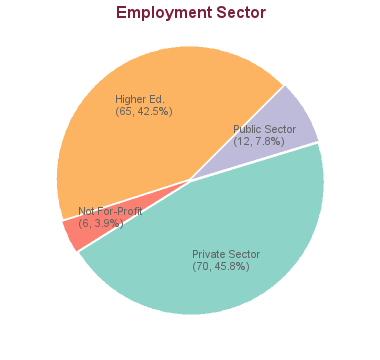
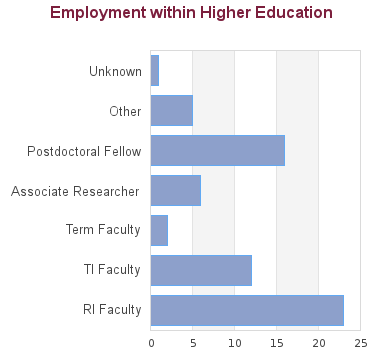
These statistics show data for the Doctor of Philosophy in Chemistry (PhD). Data are separated for each degree program combination. You may view data for other degree options in the respective program profile.
| 2024 | 2023 | 2022 | 2021 | 2020 | |
|---|---|---|---|---|---|
| Applications | 193 | 231 | 478 | 590 | 260 |
| Offers | 59 | 51 | 47 | 76 | 56 |
| New Registrations | 31 | 30 | 34 | 48 | 33 |
| Total Enrolment | 205 | 200 | 207 | 209 | 191 |
Students in research-based programs usually require a faculty member to function as their thesis supervisor. Please follow the instructions provided by each program whether applicants should contact faculty members.
These videos contain some general advice from faculty across UBC on finding and reaching out to a supervisor. They are not program specific.
This list shows faculty members with full supervisory privileges who are affiliated with this program. It is not a comprehensive list of all potential supervisors as faculty from other programs or faculty members without full supervisory privileges can request approvals to supervise graduate students in this program.
| Year | Citation |
|---|---|
| 2025 | Dr. Rueda-Espinosa studied some of the mechanisms by which platinum, palladium and nickel activate carbon-hydrogen, carbon-sulfur and carbon-fluorine bonds. His research provides insights that will aid in developing more efficient and sustainable methods for bond cleavage in chemical transformations. |
| 2025 | Dr. Nadeau developed sustainable nickel catalysts and methodologies that facilitate inert bond activation reactions for more sustainable organic transformations. His insights are relevant to the conversion of inert waste materials, such as methane, into value-added products. |
| 2025 | Dr. Rothchild is interested in how small molecules are made in nature. They studied how fungal enzymes make a molecule that is toxic to insects and may have applications in agriculture. Knowledge of how these enzymes work can help us develop cheaper and more sustainable ways to make important molecules that we rely on. |
| 2025 | Dr.Nyamayaro explored bioderived materials as replacements for harmful plastics in advanced applications. He chemically tailored the properties of cellulosic materials and used them to fabricate biodegradable electronics and design innovative materials with novel flow properties. His findings advance eco-friendly materials in sustainable technology |
| 2025 | Dr. Hagar discovered antimicrobial compounds from cave soil bacteria. These compounds, named 'caveamides', were found by combining genetic analysis and chemical detection methods. Beyond their pharmaceutical potential, caveamides have rare structural elements that give key insights into a poorly understood aspect of microbial biochemistry. |
| 2025 | Dr. Thomson investigated the utility of sulfur fluorides as reagents in synthetic organic chemistry. His work exemplified the utility of these reagents through expediting the syntheses of pharmaceutically-relevant motifs. |
| 2025 | Dr. Nasseri investigated the molecular mechanism of carbohydrate consumption by bacteria and devised a new strategy for developing antibacterial agents, based on the idea that a sugar-coated antibiotic can selectively target those bacteria that like to consume the specific sugar. His work will contribute to the development of future antibiotics. |
| 2025 | Dr. Zhao investigates unknown compounds and emerging pollutants in complex biofluids and the environment. She integrates artificial intelligence with mass spectrometry to facilitate the discovery of new compounds. Her work advances understanding of chemical exposures and health impacts. |
| 2025 | John Ticknor delivered groundbreaking insights into the mobility and transport of dilute-limit lithium ions in van der Waals layered materials. This process is essential in the operation of a lithium-ion battery, and the 'first of their kind' experimental results directly validated computational simulations that underpin modern battery research. |
| 2025 | Dr. Shi transformed our understanding of cross-coupling reactions through real-time monitoring techniques. By capturing the temporal signatures of all dynamic processes of a reaction, she revealed hidden reaction pathways and developed more efficient synthetic methods that dramatically reduce the manufacturing costs. |
Chemistry covers a wide range of subject matter, from synthetic organic chemistry to chemical physics and theory, including inorganic, organic, analytical, biological, physical, theoretical, nuclear, environmental, and materials chemistry.
Departments/Programs may update graduate degree program details through the Faculty & Staff portal. To update contact details for application inquiries, please use this form.