

Adam Ford
Job Title
Assistant Professor
Employer
University of British Columbia

Review details about the recently announced changes to study and work permits that apply to master’s and doctoral degree students. Read more
Department of Zoology at the University of British Columbia is one of the strongest and most broadly based life science departments in Canada, with a scope that spans from molecules to cells, whole organisms, populations, and communities. It is home to approximately forty highly funded, well-equipped research groups that are roughly equally distributed among four overlapping research clusters: evolutionary biology, ecology and conservation biology, comparative physiology, and cell, genetics and developmental biology, with many strong interdisciplinary connections among them. Our faculty are leaders in their respective fields and include Fellows of the Royal Society of London, Members of the US National Academy of Sciences, Fellows of the Royal Society of Canada, Canada Research Chairs and a Canada 150 chair. Our program offers trainees opportunities to chose from a broad range of research topics, world-class mentorship, and access to state of the art research and teaching facilities. We encourage you to visit the Department website to check out the specific research interests of the professors in the Department.
The PhD in program in Zoology provides an opportunity to learn in a vibrant, multidisciplinary research environment. Students work closely with individual faculty members who provide exceptional training and focused supervision using a mentorship model. We encourage you to visit the Department website to check out the specific research interests of our professors across our various research clusters. Each research cluster within the department holds a variety of seminars, discussion groups, workshops and other events that allow graduate students, postdoctoral fellows, visitors and faculty to enjoy regular interaction. The Department of Zoology aims to foster a community in which diversity is integral and people from all backgrounds are acknowledged and respected and that provides a supportive, collegial, and inclusive environment for graduate training. All students are supported with a guaranteed financial package throughout their graduate training. The most recent information about the stipend package is available at our departmental website.
The Faculty of Graduate and Postdoctoral Studies establishes the minimum admission requirements common to all applicants, usually a minimum overall average in the B+ range (76% at UBC). The graduate program that you are applying to may have additional requirements. Please review the specific requirements for applicants with credentials from institutions in:
Each program may set higher academic minimum requirements. Please review the program website carefully to understand the program requirements. Meeting the minimum requirements does not guarantee admission as it is a competitive process.
Applicants from a university outside Canada in which English is not the primary language of instruction must provide results of an English language proficiency examination as part of their application. Tests must have been taken within the last 24 months at the time of submission of your application.
Minimum requirements for the two most common English language proficiency tests to apply to this program are listed below:
Overall score requirement: 97
Reading
22
Writing
22
Speaking
22
Listening
22
Overall score requirement: 6.5
Reading
6.0
Writing
6.0
Speaking
6.0
Listening
6.0
Some programs require additional test scores such as the Graduate Record Examination (GRE) or the Graduate Management Test (GMAT). The requirements for this program are:
The GRE is not required.
All applicants have to submit transcripts from all past post-secondary study. Document submission requirements depend on whether your institution of study is within Canada or outside of Canada.
A minimum of two references are required for application to graduate programs at UBC. Each graduate program determines the type of reference (e.g. academic, professional) and number of references they require which can range from 2 to 4. References should be requested from individuals who are prepared to provide a report on your qualifications for the program.
Many programs require a statement of interest, sometimes called a "statement of intent", "description of research interests" or something similar.
Students in research-based programs usually require a faculty member to function as their thesis supervisor. Please follow the instructions provided by each program whether applicants should contact faculty members.
Clarification: no commitment from a supervisor prior to applying is necessary but you must contact your potential supervisor(s) before applying as many faculty won't accept students who they have not previously been in contact with.
Permanent Residents of Canada must provide a clear photocopy of both sides of the Permanent Resident card.
All applicants must complete an online application form and pay the application fee to be considered for admission to UBC.
Cell and Developmental Biology: molecular and genetic bases of development and cellular function Comparative Physiology: aspects of animal physiology from a comparative perspective, particularly those mechanisms underlying adaptive responses to environmental constraints Ecology: blends field ecology and natural history with ecological theory and conservation biology Evolution: encompasses evolutionary ecology, evolutionary genetics, conservation genetics, theory, and systematics
Original research supervised by a faculty member constitutes the major component of work toward the PhD degree. PhD students are not required to complete course work unless it is recommended by the thesis committee or unless the student has been admitted without a Master's degree. All PhD students are required to present a research proposal and pass a comprehensive examination on their research area within 18 months of their program start date. Each PhD student is expected to deliver a one-hour lecture on their completed doctoral research in one of the departmental lecture series before their doctoral dissertation examination.
| Fees | Canadian Citizen / Permanent Resident / Refugee / Diplomat | International |
|---|---|---|
| Application Fee | $116.25 | $168.25 |
| Tuition * | ||
| Installments per year | 3 | 3 |
| Tuition per installment | $1,875.34 | $3,294.66 |
| Tuition per year (plus annual increase, usually 2%-5%) | $5,626.02 | $9,883.98 |
| Int. Tuition Award (ITA) per year (if eligible) | $3,200.00 (-) | |
| Other Fees and Costs | ||
| Student Fees (yearly) | $1,144.10 (approx.) | |
| Costs of living | Estimate your costs of living with our interactive tool in order to start developing a financial plan for your graduate studies. | |
Applicants to UBC have access to a variety of funding options, including merit-based (i.e. based on your academic performance) and need-based (i.e. based on your financial situation) opportunities.
The Department of Zoology has a minimum funding policy for all Graduate students. Support will be in the form of a combination of Teaching Assistantships (TA), awards/scholarship, or Graduate Research Assistantships (GRA) paid from the supervisor’s research grants. The minimum level of support will include any tuition costs not covered by another source.
Please review our detailed funding information.
Award Deadlines:
December 1: NSERC CGSM Fellowship (must also apply for admissions by Dec 1)
Mid-January: 4 Year Fellowship or Zoology Graduate Fellowship
This results in a net balance (any funding provided to the student minus tuition and fees) mean of $32,966 and median of $31,977.
All applicants are encouraged to review the awards listing to identify potential opportunities to fund their graduate education. The database lists merit-based scholarships and awards and allows for filtering by various criteria, such as domestic vs. international or degree level.
Many professors are able to provide Research Assistantships (GRA) from their research grants to support full-time graduate students studying under their supervision. The duties constitute part of the student's graduate degree requirements. A Graduate Research Assistantship is considered a form of fellowship for a period of graduate study and is therefore not covered by a collective agreement. Stipends vary widely, and are dependent on the field of study and the type of research grant from which the assistantship is being funded.
Graduate programs may have Teaching Assistantships available for registered full-time graduate students. Full teaching assistantships involve 12 hours work per week in preparation, lecturing, or laboratory instruction although many graduate programs offer partial TA appointments at less than 12 hours per week. Teaching assistantship rates are set by collective bargaining between the University and the Teaching Assistants' Union.
Academic Assistantships are employment opportunities to perform work that is relevant to the university or to an individual faculty member, but not to support the student’s graduate research and thesis. Wages are considered regular earnings and when paid monthly, include vacation pay.
Canadian and US applicants may qualify for governmental loans to finance their studies. Please review eligibility and types of loans.
All students may be able to access private sector or bank loans.
Many foreign governments provide support to their citizens in pursuing education abroad. International applicants should check the various governmental resources in their home country, such as the Department of Education, for available scholarships.
The possibility to pursue work to supplement income may depend on the demands the program has on students. It should be carefully weighed if work leads to prolonged program durations or whether work placements can be meaningfully embedded into a program.
International students enrolled as full-time students with a valid study permit can work on campus for unlimited hours and work off-campus for no more than 24 hours a week during academic sessions.
A good starting point to explore student jobs is the UBC Work Learn program or a Co-Op placement.
Students with taxable income in Canada may be able to claim federal or provincial tax credits.
Canadian residents with RRSP accounts may be able to use the Lifelong Learning Plan (LLP) which allows students to withdraw amounts from their registered retirement savings plan (RRSPs) to finance full-time training or education for themselves or their partner.
Please review Filing taxes in Canada on the student services website for more information.
Applicants have access to the cost estimator to develop a financial plan that takes into account various income sources and expenses.
95 students graduated between 2005 and 2013: 1 graduate is seeking employment; 1 is in a non-salaried situation; for 6 we have no data (based on research conducted between Feb-May 2016). For the remaining 87 graduates:
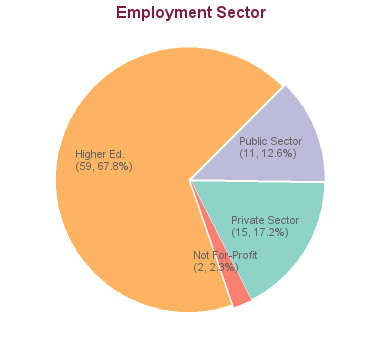
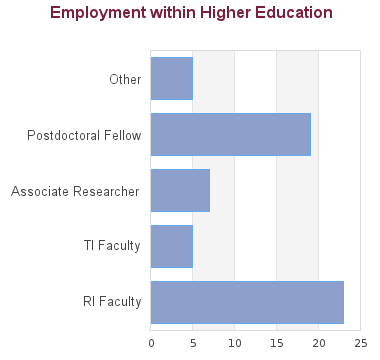
These statistics show data for the Doctor of Philosophy in Zoology (PhD). Data are separated for each degree program combination. You may view data for other degree options in the respective program profile.
| 2023 | 2022 | 2021 | 2020 | 2019 | |
|---|---|---|---|---|---|
| Applications | 34 | 26 | 30 | 23 | 30 |
| Offers | 13 | 11 | 10 | 8 | 12 |
| New Enrolment | 10 | 9 | 10 | 6 | 11 |
| Total Enrolment | 81 | 78 | 83 | 88 | 92 |
Students in research-based programs usually require a faculty member to function as their thesis supervisor. Please follow the instructions provided by each program whether applicants should contact faculty members.
Clarification: no commitment from a supervisor prior to applying is necessary but you must contact your potential supervisor(s) before applying as many faculty won't accept students who they have not previously been in contact with.
These videos contain some general advice from faculty across UBC on finding and reaching out to a supervisor. They are not program specific.



| Year | Citation |
|---|---|
| 2010 | Dr. Tyerman demonstrated that competition for resources caused experimental populations of bacteria to diversify. His work provides direct evidence that ecological interactions, like competition, can drive adaptive diversification. Subsequently he investigated how trade-offs, mutational constraints and ecological opportunities impact the origin and maintenance of bacterial diversity. |
| 2009 | Dr. Scott studied how some birds can fly over the highest mountains in the world, where oxygen is so scarce that people can barely survive. His research discovered the basis for the impressive feat of these animals, advancing our knowledge of how physiological systems evolve in nature and of the limitations of our own physiology at high altitudes. |
| 2009 | Dr. Marchinko examined the ecological and genetic mechanisms resulting in the evolution of threespine stickleback fish. His work revealed that although the factors contributing to evolutionary change are often complex, modifications at a single gene can play a major role in biological diversification. |
| 2009 | Dr. Purcell investigated why social spiders are generally restricted to the tropical rainforest, while their non-social relatives occur in a broader range of environments but are absent from the rainforest. Her findings suggest that social behaviours may evolve in part to enable groups to overcome environmental disturbances and predation in some environments. |
| 2009 | Dr. Wood studied how interactions among species in a marine ecosystem can be used to explain species diversity and the responses of ecosystems to environmental change. His research demonstrated the potential to predict ecological dynamics using simple organismal traits, such as body size, without the need for detailed information on communities. |
| 2009 | Dr. Scott examined the cellular and molecular consequences of trauma to the spinal cord. Her thesis work aimed to improve recovery following spinal cord injury and to shed light on new therapeutic strategies that promote the repair of nerves and enhance the plasticity of the central nervous system. |
| 2009 | Dr. Chantangsi used advanced microscopy and comparative genetic approaches to explore and characterize the biodiversity of a diverse group of marine microbial predators -- called cercozoan flagellates -- that thrive within the spaces between grains of sand. This research demonstrated the novel features and evolutionary interrelationships of several new species and significantly improved our understanding of microbial biodiversity in marine ecosystems. |
| 2009 | Dr. Korman showed that fluctuations in river flow caused by hydroelectric dams can reduce the growth and survival rates of early life stages of rainbow trout, and can alter their patterns of habitat use. His work provides important information for managing fish populations in large regulated rivers. |
| 2009 | Dr Jones took a unique approach to the conservation biology of critically endangered leatherback turtles by rearing leatherbacks from 45g hatchlings to 45kg juveniles at UBC. The data attained on age-at-maturity and resource requirements aid in our understanding of the impacts of human activities in the decline of leatherback populations. |
| 2008 | Dr. Beyers studied the distribution and abundance of elephants and other mammals in Central Africa and found that these are largely determined by human activity. The civil war in the Democratic Republic of Congo caused major declines in populations of elephants, poached for ivory and forest antilopes, hunted for bushmeat. |
The program vigorously promotes integrative research in biology and actively participates in several interdisciplinary programs, including the graduate programs in genetics, neuroscience, applied mathematics, and resource management.
Zoology offers a wide variety of research programs leading to the Master of Science and Doctor of Philosophy in the following areas: cell and developmental biology, community and population ecology, comparative physiology and biochemistry, neurobiology, and evolutionary biology.
Departments/Programs may update graduate degree program details through the Faculty & Staff portal. To update contact details for application inquiries, please use this form.

Find out how Vancouver enhances your graduate student experience—from the beautiful mountains and city landscapes, to the arts and culture scene, we have it all. Study-life balance at its best!