Overview
PhD students in the Department of Computer Science may focus their research in the following areas:
- Artificial Intelligence: computer vision, decision theory/game theory, knowledge representation and reasoning, intelligent user interfaces, machine learning, natural language understanding and generation, robotics and haptics.
- Computer Graphics: animation, imaging, modeling, rendering, visualization.
- Data Management and Mining: business intelligence, data integration, genomic analysis, text mining, web databases.
- Formal Verification and Analysis of Systems: analog, digital and hybrid systems, VLSI, protocols, software.
- Human Centered Technologies: human computer interaction (HCI), visual, haptic and multimodal interfaces, computer-supported cooperative work (CSCW), visual analytics.
- Networks, Systems, and Security: high performance computing/parallel processing, networking, operating systems and virtualization, security.
- Scientific Computing: numerical methods and software, differential equations, linear algebra, optimization.
- Software Engineering and Programming Languages: development tools, foundations of computation, middleware, programming languages, software engineering.
- Theory: algorithm design and analysis (including empirical), algorithmic game theory, discrete optimization, graph theory, computational geometry
What makes the program unique?
The UBC Department of Computer Science has many contacts in the computing industry. A strong rapport between the industry and research communities is beneficial to both, especially in cases where the department focuses its research to developing real-world applications.
Quick Facts
Admission Information & Requirements
1) Check Eligibility
Minimum Academic Requirements
The Faculty of Graduate and Postdoctoral Studies establishes the minimum admission requirements common to all applicants, usually a minimum overall average in the B+ range (76% at UBC). The graduate program that you are applying to may have additional requirements. Please review the specific requirements for applicants with credentials from institutions in:
Each program may set higher academic minimum requirements. Please review the program website carefully to understand the program requirements. Meeting the minimum requirements does not guarantee admission as it is a competitive process.
English Language Test
Applicants from a university outside Canada in which English is not the primary language of instruction must provide results of an English language proficiency examination as part of their application. Tests must have been taken within the last 24 months at the time of submission of your application.
Minimum requirements for the two most common English language proficiency tests to apply to this program are listed below:
TOEFL: Test of English as a Foreign Language - internet-based
Overall score requirement: 100
Reading
22
Writing
21
Speaking
21
Listening
22
IELTS: International English Language Testing System
Overall score requirement: 7.0
Reading
6.5
Writing
6.5
Speaking
6.5
Listening
6.5
Other Test Scores
Some programs require additional test scores such as the Graduate Record Examination (GRE) or the Graduate Management Test (GMAT). The requirements for this program are:
The GRE is not required.
Prior degree, course and other requirements
2) Meet Deadlines
3) Prepare Application
Transcripts
All applicants have to submit transcripts from all past post-secondary study. Document submission requirements depend on whether your institution of study is within Canada or outside of Canada.
Letters of reference
Statement of Interest
Many programs require a statement of interest, sometimes called a "statement of intent", "description of research interests" or something similar.
Supervision
Students in research-based programs usually require a faculty member to function as their thesis supervisor. Please follow the instructions provided by each program whether applicants should contact faculty members.
Instructions regarding thesis supervisor contact for this program
Citizenship Verification
Permanent Residents of Canada must provide a clear photocopy of both sides of the Permanent Resident card.
4) Apply Online
All applicants must complete an online application form and pay the application fee to be considered for admission to UBC.
Tuition & Financial Support
Tuition
| Fees | Canadian Citizen / Permanent Resident / Refugee / Diplomat | International |
|---|---|---|
| Application Fee | $118.50 | $168.25 |
| Tuition * | ||
| Installments per year | 3 | 3 |
| Tuition per installment | $1,912.84 | $3,360.55 |
| Tuition per year (plus annual increase, usually 2%-5%) | $5,738.52 | $10,081.65 |
| Int. Tuition Award (ITA) per year (for eligible individuals) | $3,200.00 (-) | |
| Other Fees and Costs | ||
| Student Fees (yearly) | $1,169.35 (approx.) | |
| Costs of living | Estimate your costs of living with our interactive tool in order to start developing a financial plan for your graduate studies. | |
All fees for the year are subject to adjustment and UBC reserves the right to change any fees without notice at any time, including tuition and student fees. Tuition fees are reviewed annually by the UBC Board of Governors. In recent years, tuition increases have been 2% for continuing domestic students and between 2% and 5% for continuing international students. New students may see higher increases in tuition. Admitted students who defer their admission are subject to the potentially higher tuition fees for incoming students effective at the later program start date. In case of a discrepancy between this webpage and the UBC Calendar, the UBC Calendar entry will be held to be correct.
Financial Support
Applicants to UBC have access to a variety of funding options, including merit-based (i.e. based on your academic performance) and need-based (i.e. based on your financial situation) opportunities.
Program Funding Packages
All full-time PhD students will receive a funding package of $46,236 per year for international students and $41,653 per year for domestic students during the first four years of their PhD program. In addition, the department provides guaranteed departmental support of $34,654 per year in the fifth year of the program. For programs extending beyond these periods, students and supervisors should discuss the availability of continued funding.
The funding package may consist of a combination of internal and external awards, teaching-related employment, research assistantships, and graduate academic assistantships. This support is contingent upon full-time registration as a UBC graduate student, satisfactory performance in assigned teaching and research assistantship duties, and maintaining good academic standing with satisfactory progress toward degree completion. CS students are expected to apply for any fellowships or scholarships for which they are eligible.
Please note that the above funding amounts are subject to annual tuition and stipend adjustments.
Funding Statistics
This results in a net balance (any funding provided to the student minus tuition and fees) mean of $35,875 and median of $34,543.
- 40 students received Teaching Assistantships. Median TA funding based on 40 students was $7,710.
- 81 students received Research Assistantships. Median RA funding based on 81 students was $25,270.
- 20 students received Academic Assistantships. Median AA funding based on 20 students was $1,044.
- 84 students received internal awards. Median internal award funding based on 84 students was $8,025.
- 6 students received external awards. Median external award funding based on 6 students was $26,680.
Review methodology
Scholarships & awards (merit-based funding)
All applicants are encouraged to review the awards listing to identify potential opportunities to fund their graduate education. The database lists merit-based scholarships and awards and allows for filtering by various criteria, such as domestic vs. international or degree level.
Graduate Research Assistantships (GRA)
Many professors are able to provide Research Assistantships (GRA) from their research grants to support full-time graduate students studying under their supervision. The duties constitute part of the student's graduate degree requirements. A Graduate Research Assistantship is considered a form of fellowship for a period of graduate study and is therefore not covered by a collective agreement. Stipends vary widely, and are dependent on the field of study and the type of research grant from which the assistantship is being funded.
Graduate Teaching Assistantships (GTA)
Graduate programs may have Teaching Assistantships available for registered full-time graduate students. Full teaching assistantships involve 12 hours work per week in preparation, lecturing, or laboratory instruction although many graduate programs offer partial TA appointments at less than 12 hours per week. Teaching assistantship rates are set by collective bargaining between the University and the Teaching Assistants' Union.
Graduate Academic Assistantships (GAA)
Academic Assistantships are employment opportunities to perform work that is relevant to the university or to an individual faculty member, but not to support the student’s graduate research and thesis. Wages are considered regular earnings and when paid monthly, include vacation pay.
Financial aid (need-based funding)
Canadian and US applicants may qualify for governmental loans to finance their studies. Please review eligibility and types of loans.
All students may be able to access private sector or bank loans.
UBC has working agreements with MPower Financing - an organization providing international students with no-cosigner, no-collateral education loans to study in Canada - and Windmill Microlending - an organization providing loans to skilled immigrants.
Foreign government scholarships
Many foreign governments provide support to their citizens in pursuing education abroad. International applicants should check the various governmental resources in their home country, such as the Department of Education, for available scholarships.
Working while studying
The possibility to pursue work to supplement income may depend on the demands the program has on students. It should be carefully weighed if work leads to prolonged program durations or whether work placements can be meaningfully embedded into a program.
International students enrolled as full-time students with a valid study permit can work on campus for unlimited hours and work off-campus for no more than 24 hours a week during academic sessions.
A good starting point to explore student jobs is the UBC Work Learn program or a Co-Op placement.
Tax credits and RRSP withdrawals
Students with taxable income in Canada may be able to claim federal or provincial tax credits.
Canadian residents with RRSP accounts may be able to use the Lifelong Learning Plan (LLP) which allows students to withdraw amounts from their registered retirement savings plan (RRSPs) to finance full-time training or education for themselves or their partner.
Please review Filing taxes in Canada on the student services website for more information.
Cost Estimator
Applicants have access to the cost estimator to develop a financial plan that takes into account various income sources and expenses.
Career Outcomes
111 students graduated between 2005 and 2013. Of these, career information was obtained for 106 alumni (based on research conducted between Feb-May 2016):
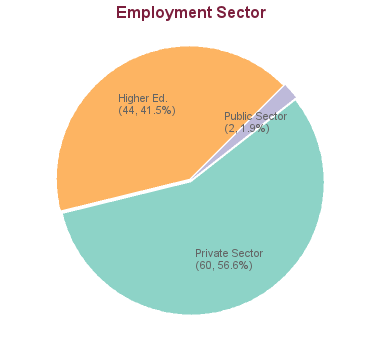
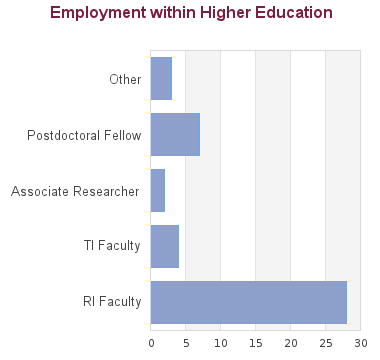
RI (Research-Intensive) Faculty: typically tenure-track faculty positions (equivalent of the North American Assistant Professor, Associate Professor, and Professor positions) in PhD-granting institutions
TI (Teaching-Intensive) Faculty: typically full-time faculty positions in colleges or in institutions not granting PhDs, and teaching faculty at PhD-granting institutions
Term Faculty: faculty in term appointments (e.g. sessional lecturers, visiting assistant professors, etc.)
Sample Employers in Higher Education
University of British Columbia (5)McGill University (3)
University of Waterloo (3)
University of Manitoba (2)
Swansea University
Stanford University
University of Utah
Ecole Polytechnique Federale de Lausanne (EPFL)
Swiss Federal Institute of Technology
University of Saskatchewan
Sample Employers Outside Higher Education
Google (12)Microsoft (4)
Amazon (3)
Intel Corporation (3)
Disney (2)
Oracle Labs (2)
IBM (2)
Tasktop Technologies (2)
Tableau (2)
OriGene Technologies Inc.
Sample Job Titles Outside Higher Education
Research Scientist (5)Software Engineer (5)
Senior Software Engineer (4)
Chief Technology Officer (3)
Product Manager (3)
Software Development Engineer (2)
Senior Data Scientist (2)
Senior Research Engineer (2)
Advisory Engineer
Senior Research Scientist
PhD Career Outcome Survey
You may view the full report on career outcomes of UBC PhD graduates on outcomes.grad.ubc.ca.Disclaimer
These data represent historical employment information and do not guarantee future employment prospects for graduates of this program. They are for informational purposes only. Data were collected through either alumni surveys or internet research.Career Options
Our faculty and students actively interact with industry in numerous fields. Via internships, consulting and the launching of new companies, they contribute to the state-of-the-art in environmental monitoring, energy prediction, software, cloud computing, search engines, social networks, advertising, e-commerce, electronic trading, entertainment games, special effects in movies, robotics, bioinformatics, biomedical engineering, and more.
Enrolment, Duration & Other Stats
These statistics show data for the Doctor of Philosophy in Computer Science (PhD). Data are separated for each degree program combination. You may view data for other degree options in the respective program profile.
ENROLMENT DATA
| 2025 | 2024 | 2023 | 2022 | 2021 | |
|---|---|---|---|---|---|
| Applications | 313 | 318 | 281 | 265 | 375 |
| Offers | 47 | 25 | 31 | 40 | 41 |
| New Registrations | 27 | 15 | 14 | 16 | 21 |
| Total Enrolment | 157 | 139 | 129 | 124 | 116 |
Completion Rates and Times
Disclaimer
Doctoral Exams Upcoming
- 246, ICICS, 2366 Main Mall
- X836, ICICS, 2366 Main Mall
Research Supervisors
Supervision
Students in research-based programs usually require a faculty member to function as their thesis supervisor. Please follow the instructions provided by each program whether applicants should contact faculty members.
Instructions regarding thesis supervisor contact for this program
Advice and insights from UBC Faculty on reaching out to supervisors
These videos contain some general advice from faculty across UBC on finding and reaching out to a supervisor. They are not program specific.
This list shows faculty members with full supervisory privileges who are affiliated with this program. It is not a comprehensive list of all potential supervisors as faculty from other programs or faculty members without full supervisory privileges can request approvals to supervise graduate students in this program.
- Allen, Kelsey (complex behaviors in humans)
- Beschastnikh, Ivan (Computer and information sciences; software engineering; distributed systems; cloud computing; software analysis; Machine Learning)
- Bowman, William (Computer and information sciences; Programming languages and software engineering; Programming languages; Compilers; programming languages)
- Carenini, Giuseppe (Natural language processing)
- Chen, Peter Yichen (computer graphics, machine learning, scientific computing, mechanics, robotics)
- Clune, Jeff
- Conati, Cristina (artificial intelligence, human-computer interaction, affective computing, personalized interfaces, intelligent user interfaces, intelligent interface agents, virtual agent, user-adapted interaction, computer-assisted education, educational computer games, computers in education, user-adaptive interaction, Artificial intelligence, adaptive interfaces, cognitive systems, user modelling)
- Condon, Anne (Bioinformatics; Computer and information sciences; Algorithms; Molecular Programming)
- Ding, Jiarui (Bioinformatics; Basic medicine and life sciences; Bioinformatics; Computational Biology; Machine Learning; Probabilistic Deep Learning; single-cell genomics; visualization; Cancer biology; Computational Immunology; Food Allergy; neuroscience)
- Feeley, Michael (Distributed systems, operating systems, workstation and pc clusters)
- Friedlander, Michael (numerical optimization, numerical linear algebra, scientific computing, Scientific computing)
- Friedman, Joel (Computer and information sciences; Algebraic Graph Theory; Combinatorics; Computer Science Theory)
- Garcia, Ronald (Programming languages; programming languages)
- Gonen, Hila (Natural Language Processing, Machine Learning and Artificial Intelligence; Control and interpretation of models: understanding model behavior and controlling model generation; Reliability, safety & fairness: making models more consistent & safe, and mitigating biases and risk; Multilinguality: creating NLP tools that equitably serve speakers of as many languages as possible)
- Greenstreet, Mark (Dynamic systems, formal methods, hybrid systems, differential equations)
- Greif, Chen (Numerical computation; Numerical analysis; Numerical analysis; scientific computing; numerical linear algebra; numerical solution of elliptic partial differential equations)
- Gujarati, Arpan (Computer and information sciences; Systems)
- Harms, Nathan (Randomized communication, Property testing vs. learning)
- Harvey, Nicholas (randomized algorithms, combinatorial optimization, graph sparsification, discrepancy theory and learning theory; algorithmic problems arising in computer networking, including cache analysis, load balancing, data replication, peer-to-peer networks, and network coding.)
- Hoang, Nguyen Phong (networking; security & privacy; network security; online privacy; Internet measurement)
- Holmes, Reid (Computer and information sciences; computer science; open source software; software comprehension; software development tools; software engineering; software quality; software testing; static analysis)
- Hutchinson, Norman (Computer and information sciences; Computer Systems; Computer Systems; distributed systems; File Systems; Virtualization)
- Lakshmanan, Laks (data management and data cleaning; data warehousing and OLAP; data and text mining; analytics on big graphs and news; social networks and media; recommender systems)
- Lecuyer, Mathias (Machine learning systems; Guarantees of robustness, privacy, and security)
- Lemieux, Caroline (Programming languages and software engineering; help developers improve the correctness, security, and performance of software systems; test-input generation; specification mining; program synthesis)
Pagination
Sample Thesis Submissions
Doctoral Citations
| Year | Citation |
|---|---|
| 2025 | Dr. Cameron developed machine learning methods to automatically improve algorithms and synthesize entirely new ones tailored to specific applications, enabling better solutions for optimizing 5G networks and power grids. He laid groundwork for richer algorithm design by building a unified model that broadly understands such computational problems. |
| 2025 | Dr. Goyal studied data-efficient learning in the area of computer vision. He developed methods which lowers annotation cost for tasks like detecting and localizing objects and actions in both images and videos. His research shows how data can be used effectively to build computational agents that understand visual content of various forms. |
| 2025 | Dr. Reda developed methods to teach virtual characters to move realistically in physics-based simulations using reinforcement learning. By addressing challenges in exploration, data limitations, and environment design, his work enables robust, adaptable controllers for applications in character animation, humanoid robotics, and virtual reality. |
| 2025 | Dr. Tanprasert is a human-computer interaction researcher. Her dissertation focuses on designing personas of AI-driven agents to increase learners’ engagement in online learning environments. Her findings provide a foundational framework for designing agents to meet the user’s social and emotional needs in the educational domain and beyond. |
| 2025 | Dr. Lavington developed algorithms for training AI systems in simulated environments by leveraging privileged information available during simulation. His methods enabled faster and safer policy learning for complex tasks like autonomous driving and locomotion, advancing the path from simulation to real-world deployment. |
| 2024 | Dr. Sanches Portella studied how to predict the future and keep secrets, mathematically speaking. He developed new online prediction algorithms and novel results on the limits of privacy-preserving data analysis. His findings may lead to more efficient optimization procedures and stronger cost-benefit analyses for private statistical estimation. |
| 2024 | Dr. Bradley examined the extraneous work software developers perform to coordinate their tools. He investigated how information already present within tools can act as a task context to ease developers' tool coordination effort. Future tools can use this task context to proactively assist developers complete their tasks more productively. |
| 2024 | Dr. Harvey developed machine learning models which generate and edit images and video. His work had a particular focus on enabling the same model to be used for many different editing tasks. Potential applications include editing films and developing controllers for robots. |
| 2024 | Dr. Tanzila has significantly advanced machine learning by developing multimodal neural networks that can understand images and videos at a high level, even with limited data. Her research focuses on teaching machine learning models to perceive the world through multiple senses, similar to how humans do. She has also contributed to multimodal generative models to address data ambiguity. |
| 2024 | Dr. Bucci developed interfaces to create meaningful interactions between computers and people using a variety of sensors and artificial intelligence approaches. Through multiple projects, he detected emotions through brainwave and touch-based data, and designed an interactive meaning-based document organization system for qualitative research of millions of documents. |
Pagination
Related Programs
Same specialization
Same Academic Unit
Further Information
Specialization
Computer Science covers Bayesian statistics and applications, bioinformatics, computational intelligence (computational vision, automated reasoning, multi-agent systems, intelligent interfaces, and machine learning), computer communications, databases, distributed and parallel systems, empirical analysis of algorithms, computer graphics, human-computer interaction, hybrid systems, integrated systems design, networks, network security, networking and multimedia, numerical methods and geometry in computer graphics, operating systems, programming languages, robotics, scientific computation, software engineering, visualization, and theoretical aspects of computer science (computational complexity, computational geometry, analysis of complex graphs, and parallel processing).
Faculty
Academic Unit
Program Identifier
Classification
Program Enquiries
Contact the program
Social Media Channels
Supervisor Search
Departments/Programs may update graduate degree program details through the Faculty & Staff portal. To update contact details for application inquiries, please use this form.

Experience the colours of Vancouver