Overview
The Department of Physics and Astronomy is a broad-based department with a wide range of research interests covering many key topics in contemporary physics, astronomy, and applied physics. We are a vibrant community that engages in a wide range of research directions, from probing the origin of the universe to exploring emergent phenomena in complex systems, that provide deep insights into the nature of the universe and practical solutions that will help define the world of tomorrow. Departmental research activities are supported by several computing and experimental facilities, and excellent electronics and machine shops.
Our graduate programs include approximately 200 graduate students, working on experiments and theory in research fields that include: Applied Physics, Astronomy/Astrophysics, Atomic/Molecular/Optics, Biophysics, Condensed Matter, Cosmology, Gravity, Medical Physics, Nuclear Physics, Particle Physics, and String Theory.
What makes the program unique?
The Department of Physics & Astronomy at UBC is noted for the excellence of its research and its high academic standards and integrity. It is one of the largest and most diverse physics and astronomy departments in Canada. We are constantly rated as one of the top Physics & Astronomy programs in the world. Much of the Department's research is enhanced by local facilities such as the TRIUMF National Laboratory, the Advanced Materials and Process Engineering Laboratory (AMPEL), and the BC Cancer Agency, UBC, and associated teaching hospitals, in addition to many specialized research laboratories housed within the Department. There is a great deal of collaboration and overlap of interests among the various groups.
Each year, our faculty bring over $20 million in research grants. This enables us to maintain world-class research laboratories and computational facilities, attract distinguished post-doctorate researchers, and support highly skilled engineers and technicians whose expertise is critical to our research.
Quick Facts
Admission Information & Requirements
1) Check Eligibility
Minimum Academic Requirements
The Faculty of Graduate and Postdoctoral Studies establishes the minimum admission requirements common to all applicants, usually a minimum overall average in the B+ range (76% at UBC). The graduate program that you are applying to may have additional requirements. Please review the specific requirements for applicants with credentials from institutions in:
Each program may set higher academic minimum requirements. Please review the program website carefully to understand the program requirements. Meeting the minimum requirements does not guarantee admission as it is a competitive process.
English Language Test
Applicants from a university outside Canada in which English is not the primary language of instruction must provide results of an English language proficiency examination as part of their application. Tests must have been taken within the last 24 months at the time of submission of your application.
Minimum requirements for the two most common English language proficiency tests to apply to this program are listed below:
TOEFL: Test of English as a Foreign Language - internet-based
Overall score requirement: 90
Reading
22
Writing
21
Speaking
21
Listening
22
IELTS: International English Language Testing System
Overall score requirement: 6.5
Reading
6.0
Writing
6.0
Speaking
6.0
Listening
6.0
Other Test Scores
Some programs require additional test scores such as the Graduate Record Examination (GRE) or the Graduate Management Test (GMAT). The requirements for this program are:
The GRE is not required.
2) Meet Deadlines
3) Prepare Application
Transcripts
All applicants have to submit transcripts from all past post-secondary study. Document submission requirements depend on whether your institution of study is within Canada or outside of Canada.
Letters of reference
Statement of Interest
Many programs require a statement of interest, sometimes called a "statement of intent", "description of research interests" or something similar.
Supervision
Students in research-based programs usually require a faculty member to function as their thesis supervisor. Please follow the instructions provided by each program whether applicants should contact faculty members.
Instructions regarding thesis supervisor contact for this program
Citizenship Verification
Permanent Residents of Canada must provide a clear photocopy of both sides of the Permanent Resident card.
4) Apply Online
All applicants must complete an online application form and pay the application fee to be considered for admission to UBC.
Research Information
Research Focus
Tuition & Financial Support
Tuition
| Fees | Canadian Citizen / Permanent Resident / Refugee / Diplomat | International |
|---|---|---|
| Application Fee | $118.50 | $168.25 |
| Tuition * | ||
| Installments per year | 3 | 3 |
| Tuition per installment | $1,912.84 | $3,360.55 |
| Tuition per year (plus annual increase, usually 2%-5%) | $5,738.52 | $10,081.65 |
| Int. Tuition Award (ITA) per year (for eligible individuals) | $3,200.00 (-) | |
| Other Fees and Costs | ||
| Student Fees (yearly) | $1,169.35 (approx.) | |
| Costs of living | Estimate your costs of living with our interactive tool in order to start developing a financial plan for your graduate studies. | |
All fees for the year are subject to adjustment and UBC reserves the right to change any fees without notice at any time, including tuition and student fees. Tuition fees are reviewed annually by the UBC Board of Governors. In recent years, tuition increases have been 2% for continuing domestic students and between 2% and 5% for continuing international students. New students may see higher increases in tuition. Admitted students who defer their admission are subject to the potentially higher tuition fees for incoming students effective at the later program start date. In case of a discrepancy between this webpage and the UBC Calendar, the UBC Calendar entry will be held to be correct.
Financial Support
Applicants to UBC have access to a variety of funding options, including merit-based (i.e. based on your academic performance) and need-based (i.e. based on your financial situation) opportunities.
Program Funding Packages
All full-time students in UBC-Vancouver PhD programs will be provided with a funding package of at least $40,000 for each of the first four years of their PhD from September 2026. The funding package may consist of any combination of internal or external awards, teaching-related work, research assistantships, and graduate academic assistantships. Please check with your prospective graduate program for specific details of the funding provided to its PhD students.
Funding Statistics
This results in a net balance (any funding provided to the student minus tuition and fees) mean of $30,274 and median of $31,996.
- 39 students received Teaching Assistantships. Median TA funding based on 39 students was $9,467.
- 48 students received Research Assistantships. Median RA funding based on 48 students was $17,500.
- 1 student received Academic Assistantships valued at $1,735.
- 66 students received internal awards. Median internal award funding based on 66 students was $8,025.
- 13 students received external awards. Median external award funding based on 13 students was $28,333.
Review methodology
Scholarships & awards (merit-based funding)
All applicants are encouraged to review the awards listing to identify potential opportunities to fund their graduate education. The database lists merit-based scholarships and awards and allows for filtering by various criteria, such as domestic vs. international or degree level.
Graduate Research Assistantships (GRA)
Many professors are able to provide Research Assistantships (GRA) from their research grants to support full-time graduate students studying under their supervision. The duties constitute part of the student's graduate degree requirements. A Graduate Research Assistantship is considered a form of fellowship for a period of graduate study and is therefore not covered by a collective agreement. Stipends vary widely, and are dependent on the field of study and the type of research grant from which the assistantship is being funded.
Graduate Teaching Assistantships (GTA)
Graduate programs may have Teaching Assistantships available for registered full-time graduate students. Full teaching assistantships involve 12 hours work per week in preparation, lecturing, or laboratory instruction although many graduate programs offer partial TA appointments at less than 12 hours per week. Teaching assistantship rates are set by collective bargaining between the University and the Teaching Assistants' Union.
Graduate Academic Assistantships (GAA)
Academic Assistantships are employment opportunities to perform work that is relevant to the university or to an individual faculty member, but not to support the student’s graduate research and thesis. Wages are considered regular earnings and when paid monthly, include vacation pay.
Financial aid (need-based funding)
Canadian and US applicants may qualify for governmental loans to finance their studies. Please review eligibility and types of loans.
All students may be able to access private sector or bank loans.
UBC has working agreements with MPower Financing - an organization providing international students with no-cosigner, no-collateral education loans to study in Canada - and Windmill Microlending - an organization providing loans to skilled immigrants.
Foreign government scholarships
Many foreign governments provide support to their citizens in pursuing education abroad. International applicants should check the various governmental resources in their home country, such as the Department of Education, for available scholarships.
Working while studying
The possibility to pursue work to supplement income may depend on the demands the program has on students. It should be carefully weighed if work leads to prolonged program durations or whether work placements can be meaningfully embedded into a program.
International students enrolled as full-time students with a valid study permit can work on campus for unlimited hours and work off-campus for no more than 24 hours a week during academic sessions.
A good starting point to explore student jobs is the UBC Work Learn program or a Co-Op placement.
Tax credits and RRSP withdrawals
Students with taxable income in Canada may be able to claim federal or provincial tax credits.
Canadian residents with RRSP accounts may be able to use the Lifelong Learning Plan (LLP) which allows students to withdraw amounts from their registered retirement savings plan (RRSPs) to finance full-time training or education for themselves or their partner.
Please review Filing taxes in Canada on the student services website for more information.
Cost Estimator
Applicants have access to the cost estimator to develop a financial plan that takes into account various income sources and expenses.
Career Outcomes
108 students graduated between 2005 and 2013: 2 graduates are seeking employment; for 11 we have no data (based on research conducted between Feb-May 2016). For the remaining 95 graduates:
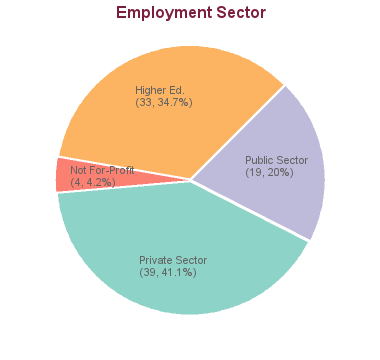
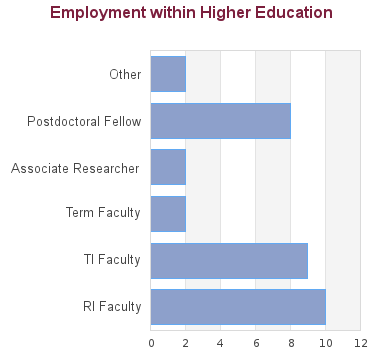
RI (Research-Intensive) Faculty: typically tenure-track faculty positions (equivalent of the North American Assistant Professor, Associate Professor, and Professor positions) in PhD-granting institutions
TI (Teaching-Intensive) Faculty: typically full-time faculty positions in colleges or in institutions not granting PhDs, and teaching faculty at PhD-granting institutions
Term Faculty: faculty in term appointments (e.g. sessional lecturers, visiting assistant professors, etc.)
Sample Employers in Higher Education
University of British Columbia (7)Simon Fraser University (2)
Goethe University Frankfurt
Stanford University
Queen Mary University of London
University of Michigan - Ann Arbor
Duke University
Washington University in St Louis
Beijing Normal University
Harvard University
Sample Employers Outside Higher Education
BC Cancer Agency (8)United States Department of Energy (3)
1QB Information Technologies (1QBit) (2)
European Organization for Nuclear Research (CERN) (2)
MTT Innovation Inc. (2)
Google (2)
Coanda Research and Development Corporation (2)
FINCAD (2)
Bayer (2)
Ottawa Hospital
Sample Job Titles Outside Higher Education
Medical Physicist (10)Data Scientist (2)
Research Scientist (2)
Engineer (2)
Director (2)
Software Engineer (2)
Staff Scientist (2)
Senior Strategy Consultant
Product Engineer
Chief Executive Officer
PhD Career Outcome Survey
You may view the full report on career outcomes of UBC PhD graduates on outcomes.grad.ubc.ca.Disclaimer
These data represent historical employment information and do not guarantee future employment prospects for graduates of this program. They are for informational purposes only. Data were collected through either alumni surveys or internet research.Enrolment, Duration & Other Stats
These statistics show data for the Doctor of Philosophy in Physics (PhD). Data are separated for each degree program combination. You may view data for other degree options in the respective program profile.
ENROLMENT DATA
| 2025 | 2024 | 2023 | 2022 | 2021 | |
|---|---|---|---|---|---|
| Applications | 84 | 76 | 102 | 90 | 103 |
| Offers | 8 | 15 | 25 | 16 | 19 |
| New Registrations | 5 | 12 | 14 | 14 | 15 |
| Total Enrolment | 95 | 105 | 111 | 114 | 112 |
Completion Rates and Times
Disclaimer
Doctoral Exams Upcoming
- Room 200
Research Supervisors
Supervision
Students in research-based programs usually require a faculty member to function as their thesis supervisor. Please follow the instructions provided by each program whether applicants should contact faculty members.
Instructions regarding thesis supervisor contact for this program
Advice and insights from UBC Faculty on reaching out to supervisors
These videos contain some general advice from faculty across UBC on finding and reaching out to a supervisor. They are not program specific.
This list shows faculty members with full supervisory privileges who are affiliated with this program. It is not a comprehensive list of all potential supervisors as faculty from other programs or faculty members without full supervisory privileges can request approvals to supervise graduate students in this program.
- Aronson, Meigan (heavy-ferromagnetic compounds; charge density waves; magnetic nanoparticles)
- Berciu, Mona (Electronic and magnetic properties of condensed matter and supraconductivity; Physical sciences; condensed matter theory; polarons, bipolarons; strongly correlated systems)
- Boley, Aaron (Astronomy and Astrophysics; Planet formation, protoplanetary disk evolution, formation of meteorite parent bodies)
- Bryman, Douglas (Particle physics, experimental; Experimental Particle Physics; Applied physics; physics)
- Burke, Sarah (Scanning probe microscopy, organic materials, nanoscale materials, surface physics, photovoltaics)
- Choptuik, Matthew (Theoretical physics, Relativity/Computational Physics)
- Damascelli, Andrea (Electronic and magnetic properties of condensed matter and supraconductivity; Electronic Structure of Quantum Materials)
- Dierker, Steve (Collective dynamics of condensed matter systems; Dependence on reduced dimensionality, strong interactions, disorder, and mesoscale structure; Collective dynamics of condensed matter systems, Dependence on reduced dimensionality, strong interactions, disorder, and mesoscale structure)
- El Baggari, Ismail (quantum materials)
- Folk, Joshua (Physical sciences; 2D materials and Vanderwaals heterostructures; Quantum electronics; Thermodynamics of quantum systems; Strongly correlated phenomena; Topological phenomena; Quantum transport)
- Franz, Marcel (Condensed matter theory)
- Gay, Colin (Experimental subatomic physics, Beyond Standard Model physics, Extra dimensions)
- Gladman, Brett (Astronomy, Planetary Science, meteorites, astrobiology, Solar system formation and evolution)
- Hallas, Alannah (Condensed matter experiments; Solid state chemistry; Quantum materials; Materials design and discovery; magnetism; Disorder; superconductivity)
- Halpern, Mark (Cosmology, Cosmic background radiation, history of star formation, measuring the geometry and contents of the Universe, satellites, balloon-borne telescopes, the physics of music, Physics of music, Cosmic Microwave Background, Physical Cosmology, Star formation history)
- Hasinoff, Michael (Low-energy particle physics)
- Hearty, Christopher (Particle physics, experimental; Experimental Particle Physics; e+e- collider; Physics beyond the Standard Model; Dark sector; dark matter)
- Heyl, Jeremy (Astronomical and space sciences; Physical sciences; Astrophysics; Black Holes; Neutron Stars; quantum phenomena; Quantum-Field Theory; Stellar; Stellar Physics)
- Hinshaw, Gary (cosmology, cosmic background radiation, Cosmology, Measuring diffuse background radiations)
- Jones, David (Atomic, optical and molecular physics,Ultrafast Optics, Spectroscopy)
- Karczmarek, Joanna (Particle physics theory (including aspects of field theory and string theory); Physical sciences; Emergent spacetime and gravity; Matrix models; Noncommutative geometry; String theory)
- Kunimoto, Michelle (exoplanet detection, characterization, and demographics)
- Leslie, Sabrina
- Lister, Alison (Particle physics, experimental; Large Hadron Collier (LHC); ATLAS experiment; Search for physics beyond the standard model; top quarks; dark matter; Machine Learning; Long-lived particles)
- MacFarlane, Andrew (Electronic and magnetic properties of condensed matter and supraconductivity; Nuclear chemistry; Development and applications of spectroscopic and structural techniques; Surfaces and structural properties of condensed matter; Solid state chemistry; Characterization of materials; Condensed matter experiments; Condensed matter characterization technique development; Condensed matter physics)
Pagination
Sample Thesis Submissions
Doctoral Citations
| Year | Citation |
|---|---|
| 2025 | Dr. Kinach studied particle-like objects called 'solitons' which arise in many areas of Nature. Using supercomputer simulations, he showed that electromagnetic fields can significantly alter the behaviour of these objects in some mathematical models. This research advances our understanding of solitons in fundamental theories of physics. |
| 2025 | Dr. Pathak’s research focused on the interplay between topology and unconventional superconductivity in layered, two-dimensional quantum materials. Her research predicted novel mechanisms for topological phase formation, occurrence of Majorana modes and spontaneous edge currents, contributing to the development of future quantum technologies. |
| 2025 | Dr. Fleury searched for evidence of new physics affecting white dwarfs, which are stellar remnants whose cooling rate could be altered by the emission of hypothesized particles such as axions. By comparing predictions from stellar evolution simulations to observations, she tested white dwarf cooling models and found new constraints on axion models. |
| 2025 | Dr. Dufresne studied the ultrafast electron dynamics of a novel quantum material, revealing how electronic interactions drive its exotic insulating state. Utilising a developed laser system to and probe ultrathin samples, their work showed how light and dimensionality can tune and control emergent quantum phases. |
| 2025 | Dr. Leckenby studied exotic nuclear decay that occurs in the core of stars to understand how the heavy elements were created. The experiment he analysed on thallium-205 was essential in predicting the amount of lead-205 in the first meteorites formed in our Solar System. These meteorites indicate that our Sun took 10 million years to form. |
| 2025 | Dr. Kirmizibayrak developed and applied novel timing methodologies for astronomy to probe astrophysical objects through their timing variability and time lags. She examined black holes, neutron stars and supernova remnants through novel approaches in timing, spectral and polarimetry analyses. |
| 2025 | Where did the matter that forms our Universe come from? The answer to this question may lie in elusive properties of particles called electric dipole moments, or EDMs. Dr. Vanbergen's research on ultracold neutrons is part of a decades-long effort to measure the neutron EDM, and has advanced this effort towards an unprecedented level of precision. |
| 2025 | Dr. Derriche studied how electric polarization affects a wide class of solids. He discovered that relaxing common approximations in the treatment of polarization leads to the emergence of interesting behaviors explaining experimental results related to lattice distortions, topological insulators and high-temperature superconductors. |
| 2024 | Dr. Korchinski developed theories explaining the statistical properties of the cascading rearrangements observed in disordered solids and crumpled sheets. |
| 2024 | Dr. Yang investigated a series of emergent phenomena in atomically thin quantum materials with rhombohedral stacking. Dr. Yang's research offers new insights into the intertwined relationship between excitons, two-dimensional ferroelectricity and correlated physics. |
Pagination
Related Programs
Same specialization
Further Information
Specialization
Physics provides research opportunities in many subfields of physics, including
- applied physics: this effort has spawned a number of spin-off companies.
- medical physics: be involved in a broad range of medical physics research in the areas of radiation therapy, medical imaging, biomedical optics and radiation biophysics.
- biophysics: the application of quantitative principles and methods to biological systems.
- nuclear and particle physics: the aim of subatomic physics is to understand matter and the fundamental forces in the universe and ultimately form a Theory of Everything.
- astronomy and astrophysics: study stars, galaxies, the material in between, and the Universe as a whole.
- atomic, molecular, and optical physics: this field is rapidly expanding and serves as the basis for many modern technological innovations.
- condensed matter physics is concerned with understanding and exploiting the properties of solids and liquids and the large area that this covers makes it the largest field of contemporary physics.
- theoretical physics: Gravity and Relativity, String Theory, High Energy Physics, and Condensed Matter Theory, to Quantum Information and Biophysics
Program Website
Faculty
Academic Unit
Program Identifier
Classification
Program Enquiries
Contact the program
Social Media Channels
Supervisor Search
Departments/Programs may update graduate degree program details through the Faculty & Staff portal. To update contact details for application inquiries, please use this form.
Curious about life in Vancouver?