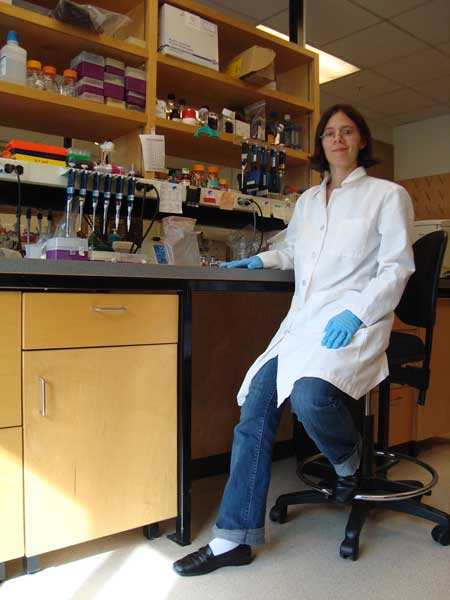
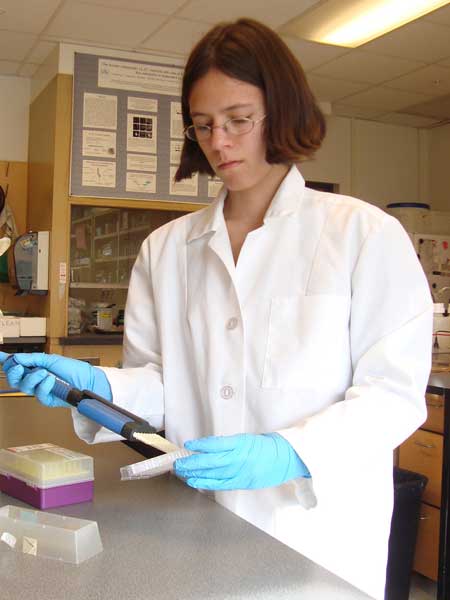
Katharine Sedivy-Haley

Designing improved anti-infective peptides
Providence
United States of America
Why did you decide to pursue a graduate degree?
I want to contribute to expanding human knowledge. That means research, and that generally means graduate studies.
Why did you decide to study at UBC?
I came to UBC in order to study under the supervision of Dr. Hancock. I'd investigated Canadian researchers with work applicable to antibiotic resistance, and Dr. Hancock's research struck me as particularly interesting. My interview confirmed this impression and also gave me a look at the friendly, positive lab environment. I wanted to be a part of it.
What was the best surprise about UBC or life in Vancouver?
How much I enjoy hanging out with my colleagues.
What do you hope to accomplish with your research?
I hope to help stem the growing health problem of antibiotic resistance. Though antibiotics have long been a highly effective tool in treating infection, we need a new approach. IDR peptides may be that approach. In mouse models, these peptides appear to be effective against a broad range of pathogens, including drug-resistant strains, and can also limit harmful inflammation and protect against life-threatening septic shock.
What has winning a major award meant to you?
I hope that during my PhD I will be able to produce research that justifies the award.
What advice do you have for new graduate students?
Come to grad school because you want to be here, not just because you can't think of something else to do. Also, apply for scholarships even if you think it's a long shot. Worst case scenario – you'll get practice writing scholarship/grant applications.
What does reaching graduation mean to you?
I am looking forward to applying the skills I gained during my PhD to fresh challenges.
Looking back over the past several years, what will you miss most of your PhD journey?
The UBC graduate student community - my colleagues in the lab, in the Graduate Student Society, and elsewhere on campus.