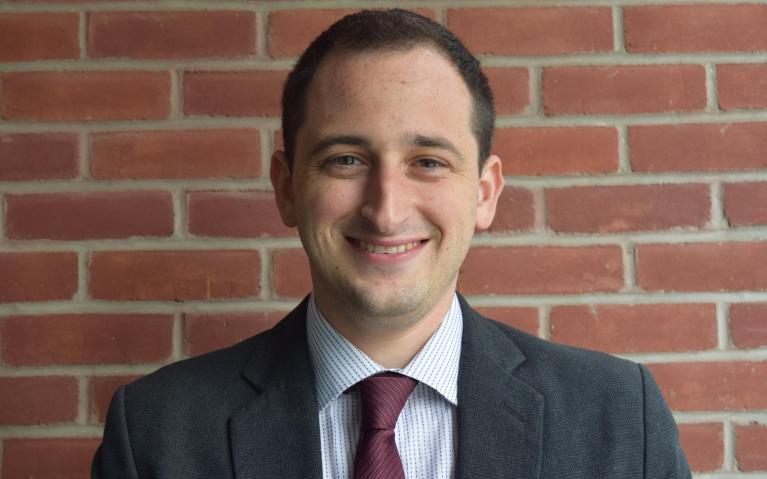
Zak Witkower
Job Title
Postdoctoral Researcher
Employer
University of Toronto

Applicants to Master’s and Doctoral degrees are not affected by the recently announced cap on study permits. Review more details
Psychology is a diverse discipline that attempts to understand the basis of behaviour, thoughts and emotions. Psychology at UBC was introduced as a single course in 1915 and was initially offered by the Department of Philosophy. Over the years, the number of courses and instructors grew until we officially became the Department of Psychology in 1958.
Information on research areas offered in the department, as well as admissions-related information, can be found on the department website. Read the department program website carefully before contacting the department with specific questions that are not addressed on the website.
UBC’s Department of Psychology is a top ranked research department in Canada and in the world. Our 58 faculty members and 130 full-time graduate students and postdoctoral fellows conduct research across the spectrum of psychology, representing seven sub-disciplinary specializations: Behavioural Neuroscience, Clinical, Cognitive Science, Developmental, Health, Quantitative Methods, and Social/Personality.
The strength of our graduate programs lies in the highly productive research faculty, well-organized programs of study, extensive opportunities for student-faculty interaction, and rich offering of research specializations. Our faculty are well known for their research expertise in health, happiness, language acquisition, gambling, child development, gender roles, environmental behaviour, neuroscience, and many other areas of psychology. Our research programs are well funded by major national granting agencies, and our faculty are committed to research excellence and interdisciplinary collaborations within UBC’s Faculties of Medicine, Science and Arts, the Institute for Resources, Environment and Sustainability and many other institutions around the world.
Please refer to the department website for all admissions-related information.
The Faculty of Graduate and Postdoctoral Studies establishes the minimum admission requirements common to all applicants, usually a minimum overall average in the B+ range (76% at UBC). The graduate program that you are applying to may have additional requirements. Please review the specific requirements for applicants with credentials from institutions in:
Each program may set higher academic minimum requirements. Please review the program website carefully to understand the program requirements. Meeting the minimum requirements does not guarantee admission as it is a competitive process.
Applicants from a university outside Canada in which English is not the primary language of instruction must provide results of an English language proficiency examination as part of their application. Tests must have been taken within the last 24 months at the time of submission of your application.
Minimum requirements for the two most common English language proficiency tests to apply to this program are listed below:
Overall score requirement: 90
Reading
22
Writing
21
Speaking
21
Listening
22
Overall score requirement: 6.5
Reading
6.0
Writing
6.0
Speaking
6.0
Listening
6.0
Some programs require additional test scores such as the Graduate Record Examination (GRE) or the Graduate Management Test (GMAT). The requirements for this program are:
The GRE is required by some applicants. Please check the program website.
A thesis-based MA or MSc in Psychology is required for applicants applying for the PhD program. Applicants with only a BA/BSc degree must aply for the MA program as they are ineligible for the PhD program.
GRE requirements vary depending on the area of research and/or intended research supervisor. Please visit the respective Research Stream page on the department website for area-specific GRE requirements.
All applicants have to submit transcripts from all past post-secondary study. Document submission requirements depend on whether your institution of study is within Canada or outside of Canada.
A minimum of three references are required for application to graduate programs at UBC. References should be requested from individuals who are prepared to provide a report on your academic ability and qualifications.
Many programs require a statement of interest, sometimes called a "statement of intent", "description of research interests" or something similar.
Students in research-based programs usually require a faculty member to function as their thesis supervisor. Please follow the instructions provided by each program whether applicants should contact faculty members.
Applicants will not be admitted without identifying a faculty member as their intended supervisor. Admissions decisions are made by prospective research supervisors; applicants are encouraged to reach out to them directly for further inquiries after reviewing the information on the department's website.
Permanent Residents of Canada must provide a clear photocopy of both sides of the Permanent Resident card.
All applicants must complete an online application form and pay the application fee to be considered for admission to UBC.
We offer research-intensive graduate studies in seven sub-disciplinary specializations: Behavioural Neuroscience, Clinical, Cognitive Science, Developmental, Health, Quantitative Methods, and Social/Personality. Please refer to the department's Research Streams page for more information.
| Fees | Canadian Citizen / Permanent Resident / Refugee / Diplomat | International |
|---|---|---|
| Application Fee | $114.00 | $168.25 |
| Tuition * | ||
| Installments per year | 3 | 3 |
| Tuition per installment | $1,838.57 | $3,230.06 |
| Tuition per year (plus annual increase, usually 2%-5%) | $5,515.71 | $9,690.18 |
| Int. Tuition Award (ITA) per year (if eligible) | $3,200.00 (-) | |
| Other Fees and Costs | ||
| Student Fees (yearly) | $1,116.60 (approx.) | |
| Costs of living | Estimate your costs of living with our interactive tool in order to start developing a financial plan for your graduate studies. | |
Applicants to UBC have access to a variety of funding options, including merit-based (i.e. based on your academic performance) and need-based (i.e. based on your financial situation) opportunities.
From September 2024 all full-time students in UBC-Vancouver PhD programs will be provided with a funding package of at least $24,000 for each of the first four years of their PhD. The funding package may consist of any combination of internal or external awards, teaching-related work, research assistantships, and graduate academic assistantships. Please note that many graduate programs provide funding packages that are substantially greater than $24,000 per year. Please refer to the department's Funding page for additional information on funding opportunities.
All applicants are encouraged to review the awards listing to identify potential opportunities to fund their graduate education. The database lists merit-based scholarships and awards and allows for filtering by various criteria, such as domestic vs. international or degree level.
Many professors are able to provide Research Assistantships (GRA) from their research grants to support full-time graduate students studying under their supervision. The duties constitute part of the student's graduate degree requirements. A Graduate Research Assistantship is considered a form of fellowship for a period of graduate study and is therefore not covered by a collective agreement. Stipends vary widely, and are dependent on the field of study and the type of research grant from which the assistantship is being funded.
Graduate programs may have Teaching Assistantships available for registered full-time graduate students. Full teaching assistantships involve 12 hours work per week in preparation, lecturing, or laboratory instruction although many graduate programs offer partial TA appointments at less than 12 hours per week. Teaching assistantship rates are set by collective bargaining between the University and the Teaching Assistants' Union.
Academic Assistantships are employment opportunities to perform work that is relevant to the university or to an individual faculty member, but not to support the student’s graduate research and thesis. Wages are considered regular earnings and when paid monthly, include vacation pay.
Canadian and US applicants may qualify for governmental loans to finance their studies. Please review eligibility and types of loans.
All students may be able to access private sector or bank loans.
Many foreign governments provide support to their citizens in pursuing education abroad. International applicants should check the various governmental resources in their home country, such as the Department of Education, for available scholarships.
The possibility to pursue work to supplement income may depend on the demands the program has on students. It should be carefully weighed if work leads to prolonged program durations or whether work placements can be meaningfully embedded into a program.
International students enrolled as full-time students with a valid study permit can work on campus for unlimited hours and work off-campus for no more than 20 hours a week.
A good starting point to explore student jobs is the UBC Work Learn program or a Co-Op placement.
Students with taxable income in Canada may be able to claim federal or provincial tax credits.
Canadian residents with RRSP accounts may be able to use the Lifelong Learning Plan (LLP) which allows students to withdraw amounts from their registered retirement savings plan (RRSPs) to finance full-time training or education for themselves or their partner.
Please review Filing taxes in Canada on the student services website for more information.
Applicants have access to the cost estimator to develop a financial plan that takes into account various income sources and expenses.
112 students graduated between 2005 and 2013: 1 is in a non-salaried situation; for 5 we have no data (based on research conducted between Feb-May 2016). For the remaining 106 graduates:
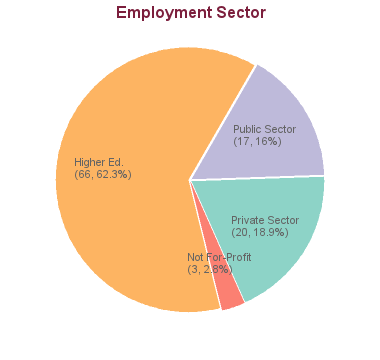
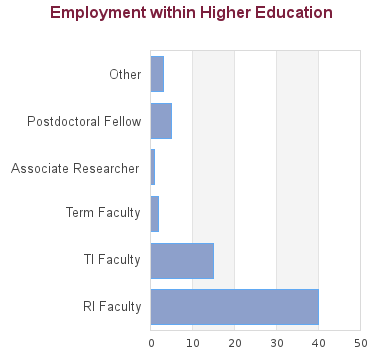
These statistics show data for the Doctor of Philosophy in Psychology (PhD). Data are separated for each degree program combination. You may view data for other degree options in the respective program profile.
| 2023 | 2022 | 2021 | 2020 | 2019 | |
|---|---|---|---|---|---|
| Applications | 142 | 151 | 183 | 120 | 129 |
| Offers | 28 | 14 | 12 | 16 | 17 |
| New Registrations | 27 | 14 | 11 | 14 | 16 |
| Total Enrolment | 95 | 85 | 82 | 90 | 88 |
Students in research-based programs usually require a faculty member to function as their thesis supervisor. Please follow the instructions provided by each program whether applicants should contact faculty members.
Applicants will not be admitted without identifying a faculty member as their intended supervisor. Admissions decisions are made by prospective research supervisors; applicants are encouraged to reach out to them directly for further inquiries after reviewing the information on the department's website.
These videos contain some general advice from faculty across UBC on finding and reaching out to a supervisor. They are not program specific.

This list shows faculty members with full supervisory privileges who are affiliated with this program. It is not a comprehensive list of all potential supervisors as faculty from other programs or faculty members without full supervisory privileges can request approvals to supervise graduate students in this program.
| Year | Citation |
|---|---|
| 2023 | Dr. Nutini examined the association of self-compassion with emotional and biological markers of stress in youth. Evidence showed that greater self-compassion was associated with less negative emotions across a variety of stressors. |
| 2023 | Dr. Khalis examined how social media usage and psychopathology impact one another. He found that certain aspects of social media usage can increase risk for depression, anxiety, and ADHD symptoms, and that psychopathology can also influence how we use social media. This research underscores the importance of mental health in the online context. |
| 2023 | Dr. Lee explored how engaging in prosocial behavior, including acts of kindness and helping others, can help individuals restore their social connections. Her research suggests that an intervention promoting prosocial behavior is a promising approach to address loneliness and social isolation, particularly for individuals experiencing chronic loneliness. |
| 2023 | Dr. Dramkin investigated how we map number words to perceptual magnitudes. Her work shows that by understanding the shared logic between number words and perceptual scales, young children can readily attach number words to their perception of number, length, and area, and even perform intuitive mathematic computations (e.g., division). |
| 2023 | Dr. Stewart's thesis investigates how the perception of mind in inanimate entities affects moral judgments. His studies suggest that perceiving the 'mind' of such objects, ideas, and emotions can shape our moral decisions and emotional regulations. These insights have implications for advancing our understanding of human moral psychology. |
| 2023 | Dr. Schmalor's research shows that subjective SES and economic inequality influence self-centeredness. High inequality and high SES both make people more self-centered, and the gap in self-centeredness between high and low SES is bigger when inequality is high. This suggests that the selfishness of the rich depends on their economic environment. |
| 2023 | Dr. Mercadante's research provides evidence to suggest that one reason why greedy people always want more and are never satisfied with what they own is because they feel a brief boost of pride upon acquisition, such that the act of acquiring something is a highly positive emotional experience, but owning the item afterward does not elicit pride. |
| 2023 | Dr. Engstrom explored how someone's social class affects how much we trust them. She found people see lower-class people as more moral - but they also implicitly associate low social class with immorality, and believe lower-class people are more tempted by financial need to betray trust. This research shows the complexity of class stereotypes. |
| 2023 | Dr. Luo examined the underlying cognitive mechanisms of behavioural interventions. He developed a framework that organizes interventions according to cognitive principles and helps inform the design and development of future interventions based on cognitive insights. |
| 2023 | Dr. Brooks examined the relationships between gambling and video games, specifically "loot boxes", a feature where players pay for in-game randomized rewards of varying values. He found that gambling-related cognitions associate with loot box use, and that loot box use also predicts subsequent gambling. These results support regulation of loot boxes. |
Psychology covers most major areas of the discipline, including: behavioral neuroscience, clinical psychology, cognitive science, developmental psychology, health psychology, personality and social psychology, and quantitative methods.
Departments/Programs may update graduate degree program details through the Faculty & Staff portal. To update contact details for application inquiries, please use this form.

Here, you can choose from more than 300 graduate degree program options and 2000+ research supervisors. You can even design your own program.