Adam Ford
Job Title
Assistant Professor
Employer
University of British Columbia

Review details about the recently announced changes to study and work permits that apply to master’s and doctoral degree students. Read more
Department of Zoology at the University of British Columbia is one of the strongest and most broadly based life science departments in Canada, with a scope that spans from molecules to cells, whole organisms, populations, and communities. It is home to approximately forty highly funded, well-equipped research groups that are roughly equally distributed among four overlapping research clusters: evolutionary biology, ecology and conservation biology, comparative physiology, and cell, genetics and developmental biology, with many strong interdisciplinary connections among them. Our faculty are leaders in their respective fields and include Fellows of the Royal Society of London, Members of the US National Academy of Sciences, Fellows of the Royal Society of Canada, Canada Research Chairs and a Canada 150 chair. Our program offers trainees opportunities to chose from a broad range of research topics, world-class mentorship, and access to state of the art research and teaching facilities. We encourage you to visit the Department website to check out the specific research interests of the professors in the Department.
The PhD in program in Zoology provides an opportunity to learn in a vibrant, multidisciplinary research environment. Students work closely with individual faculty members who provide exceptional training and focused supervision using a mentorship model. We encourage you to visit the Department website to check out the specific research interests of our professors across our various research clusters. Each research cluster within the department holds a variety of seminars, discussion groups, workshops and other events that allow graduate students, postdoctoral fellows, visitors and faculty to enjoy regular interaction. The Department of Zoology aims to foster a community in which diversity is integral and people from all backgrounds are acknowledged and respected and that provides a supportive, collegial, and inclusive environment for graduate training. All students are supported with a guaranteed financial package throughout their graduate training. The most recent information about the stipend package is available at our departmental website.
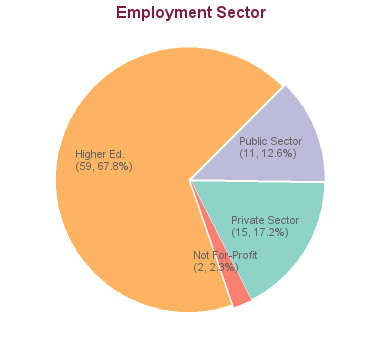
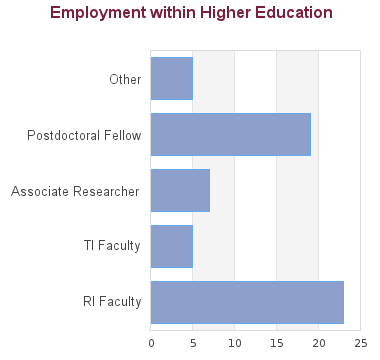
95 students graduated between 2005 and 2013: 1 graduate is seeking employment; 1 is in a non-salaried situation; for 6 we have no data (based on research conducted between Feb-May 2016). For the remaining 87 graduates:
Students in research-based programs usually require a faculty member to function as their thesis supervisor. Please follow the instructions provided by each program whether applicants should contact faculty members.
Clarification: no commitment from a supervisor prior to applying is necessary but you must contact your potential supervisor(s) before applying as many faculty won't accept students who they have not previously been in contact with.
These videos contain some general advice from faculty across UBC on finding and reaching out to a supervisor. They are not program specific.



This list shows faculty members with full supervisory privileges who are affiliated with this program. It is not a comprehensive list of all potential supervisors as faculty from other programs or faculty members without full supervisory privileges can request approvals to supervise graduate students in this program.
Departments/Programs may update graduate degree program details through the Faculty & Staff portal. To update contact details for application inquiries, please use this form.