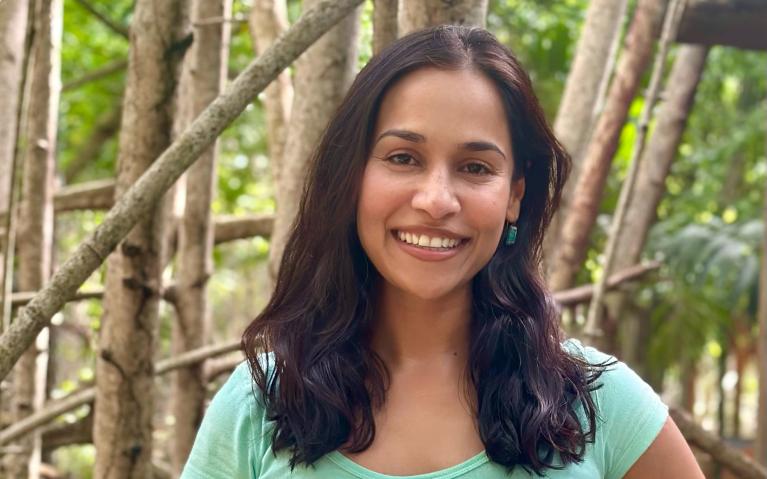

Glen Hearns
Job Title
Self Employed
Employer
Self Employed
Applicants to Master’s and Doctoral degrees are not affected by the recently announced cap on study permits. Review more details
The Institute for Resources, Environment and Sustainability (IRES) at the University of British Columbia (UBC) is a problem-focused and curiosity-driven interdisciplinary research institute and graduate program, with interest and expertise in a wide range of topics under the realm of environment and sustainability. Our mission is to foster sustainable futures through integrated research and learning about the linkages among human and natural systems, and to support decision making from local to global scales. More often than not, we achieve this through collaborations across students and faculty in a manner that recognizes our collective skills, intellectual histories and methodological approaches, and yet encourages our interdependencies as we consider real world problems.
Over fifty percent of our core faculty are Canada Research Chairs and faculty mentoring has led to a high success rate of our students winning major fellowships and scholarships. There are multi-year funding packages offered for top applicants to the RES program. RES has over 400 alumni since the graduate program started in 1994.
The Faculty of Graduate and Postdoctoral Studies establishes the minimum admission requirements common to all applicants, usually a minimum overall average in the B+ range (76% at UBC). The graduate program that you are applying to may have additional requirements. Please review the specific requirements for applicants with credentials from institutions in:
Each program may set higher academic minimum requirements. Please review the program website carefully to understand the program requirements. Meeting the minimum requirements does not guarantee admission as it is a competitive process.
Applicants from a university outside Canada in which English is not the primary language of instruction must provide results of an English language proficiency examination as part of their application. Tests must have been taken within the last 24 months at the time of submission of your application.
Minimum requirements for the two most common English language proficiency tests to apply to this program are listed below:
Overall score requirement: 100
Reading
24
Writing
24
Speaking
24
Listening
24
Overall score requirement: 7.0
Reading
6.5
Writing
6.5
Speaking
6.5
Listening
6.5
Some programs require additional test scores such as the Graduate Record Examination (GRE) or the Graduate Management Test (GMAT). The requirements for this program are:
The GRE is not required.
RES does not admit applicants to the PhD program unless they have completed a thesis-based master's degree prior to the RES PhD program start.
There are no specific prerequisites for the RES PhD program other than you must have completed a thesis-based Masters degree from a recognized institution. As we are an interdisciplinary program, we accept applications from all disciples and backgrounds. Anyone interested in studying environmental/sustainability problems in an interdisciplinary way is encouraged to apply.
The RES program requires all applicants to submit a thesis proposal with their application. Details of this can be found here: https://ires.ubc.ca/graduate-program/prospective-students/how-to-apply/
All applicants have to submit transcripts from all past post-secondary study. Document submission requirements depend on whether your institution of study is within Canada or outside of Canada.
A minimum of three references are required for application to graduate programs at UBC. References should be requested from individuals who are prepared to provide a report on your academic ability and qualifications.
Many programs require a statement of interest, sometimes called a "statement of intent", "description of research interests" or something similar.
Students in research-based programs usually require a faculty member to function as their thesis supervisor. Please follow the instructions provided by each program whether applicants should contact faculty members.
Permanent Residents of Canada must provide a clear photocopy of both sides of the Permanent Resident card.
All applicants must complete an online application form and pay the application fee to be considered for admission to UBC.
| Fees | Canadian Citizen / Permanent Resident / Refugee / Diplomat | International |
|---|---|---|
| Application Fee | $114.00 | $168.25 |
| Tuition * | ||
| Installments per year | 3 | 3 |
| Tuition per installment | $1,838.57 | $3,230.06 |
| Tuition per year (plus annual increase, usually 2%-5%) | $5,515.71 | $9,690.18 |
| Int. Tuition Award (ITA) per year (if eligible) | $3,200.00 (-) | |
| Other Fees and Costs | ||
| Student Fees (yearly) | $1,116.60 (approx.) | |
| Costs of living | Estimate your costs of living with our interactive tool in order to start developing a financial plan for your graduate studies. | |
Applicants to UBC have access to a variety of funding options, including merit-based (i.e. based on your academic performance) and need-based (i.e. based on your financial situation) opportunities.
All full-time students who begin a UBC-Vancouver PhD program in September 2024 or later will be guaranteed a minimum funding package of $24,000 for each of the first four years of their PhD. This guaranteed minimum doctoral funding package may consist of any combination of internal or external awards, teaching-related work (TA), Research assistantships (RA), and Graduate Academic Assistantships (GAA).
Additional funding opportunities for PhD applicants may come from UBC’s Four Year Doctoral Fellowship (4YF): an $18,200 stipend plus full tuition coverage per year, for four consecutive years.
RES students have also been highly successful in receiving support from the most prestigious funding agencies. Many of our students are Social Sciences and Humanities Research Council (SSHRC) or Natural Sciences and Engineering Research Council (NSERC) recipients, and in recent years we have seen our students receive both Vanier Canada Graduate Scholarships and the Trudeau Foundation Doctoral Scholarship, the most highly-regarded scholarships in Canada. You can review a detailed list of the most commonly applied to scholarships on our website.
In addition to external scholarships and funding options noted above, RES typically distributes one-time entrance awards to the majority of incoming students. The amount of these awards varies year to year, however over the last three years the awards have been in the range of $3000-$5000.
It is important for applicants to the RES program to confirm the details of any funding package that may be available to them prior to accepting an offer of admission to the program.
All applicants are encouraged to review the awards listing to identify potential opportunities to fund their graduate education. The database lists merit-based scholarships and awards and allows for filtering by various criteria, such as domestic vs. international or degree level.
Many professors are able to provide Research Assistantships (GRA) from their research grants to support full-time graduate students studying under their supervision. The duties constitute part of the student's graduate degree requirements. A Graduate Research Assistantship is considered a form of fellowship for a period of graduate study and is therefore not covered by a collective agreement. Stipends vary widely, and are dependent on the field of study and the type of research grant from which the assistantship is being funded.
Graduate programs may have Teaching Assistantships available for registered full-time graduate students. Full teaching assistantships involve 12 hours work per week in preparation, lecturing, or laboratory instruction although many graduate programs offer partial TA appointments at less than 12 hours per week. Teaching assistantship rates are set by collective bargaining between the University and the Teaching Assistants' Union.
Academic Assistantships are employment opportunities to perform work that is relevant to the university or to an individual faculty member, but not to support the student’s graduate research and thesis. Wages are considered regular earnings and when paid monthly, include vacation pay.
Canadian and US applicants may qualify for governmental loans to finance their studies. Please review eligibility and types of loans.
All students may be able to access private sector or bank loans.
Many foreign governments provide support to their citizens in pursuing education abroad. International applicants should check the various governmental resources in their home country, such as the Department of Education, for available scholarships.
The possibility to pursue work to supplement income may depend on the demands the program has on students. It should be carefully weighed if work leads to prolonged program durations or whether work placements can be meaningfully embedded into a program.
International students enrolled as full-time students with a valid study permit can work on campus for unlimited hours and work off-campus for no more than 20 hours a week.
A good starting point to explore student jobs is the UBC Work Learn program or a Co-Op placement.
Students with taxable income in Canada may be able to claim federal or provincial tax credits.
Canadian residents with RRSP accounts may be able to use the Lifelong Learning Plan (LLP) which allows students to withdraw amounts from their registered retirement savings plan (RRSPs) to finance full-time training or education for themselves or their partner.
Please review Filing taxes in Canada on the student services website for more information.
Applicants have access to the cost estimator to develop a financial plan that takes into account various income sources and expenses.
71 students graduated between 2005 and 2013: 1 graduate is seeking employment; for 8 we have no data (based on research conducted between Feb-May 2016). For the remaining 62 graduates:
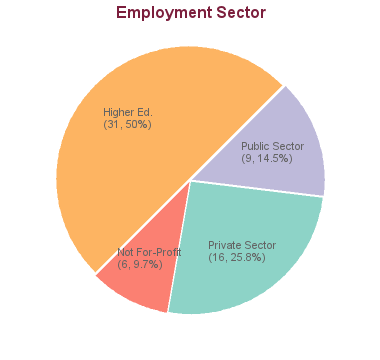
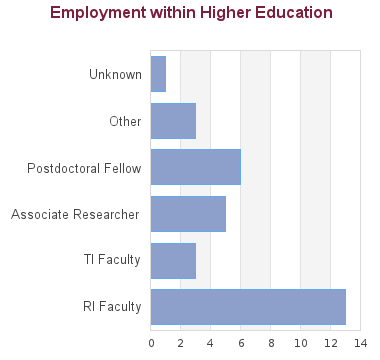
These statistics show data for the Doctor of Philosophy in Resources, Environment and Sustainability (PhD). Data are separated for each degree program combination. You may view data for other degree options in the respective program profile.
This program went through a name change in previous years that may have included curriculum changes. It was previously known as: Doctor of Philosophy in Resource Management and Environmental Studies until 2015. Historical data on this page may include data collected under the previous name(s) of the program.
| 2023 | 2022 | 2021 | 2020 | 2019 | |
|---|---|---|---|---|---|
| Applications | 49 | 69 | 90 | 62 | 71 |
| Offers | 8 | 6 | 10 | 9 | 14 |
| New Registrations | 2 | 5 | 8 | 8 | 11 |
| Total Enrolment | 47 | 50 | 49 | 52 | 57 |
Students in research-based programs usually require a faculty member to function as their thesis supervisor. Please follow the instructions provided by each program whether applicants should contact faculty members.
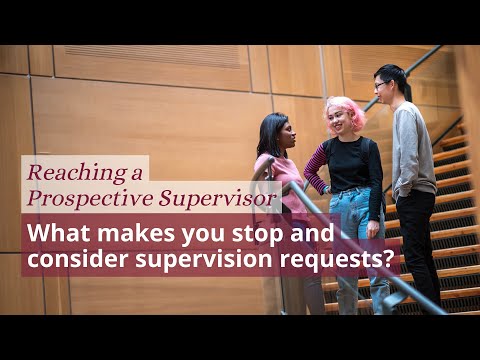
These videos contain some general advice from faculty across UBC on finding and reaching out to a supervisor. They are not program specific.


This list shows faculty members with full supervisory privileges who are affiliated with this program. It is not a comprehensive list of all potential supervisors as faculty from other programs or faculty members without full supervisory privileges can request approvals to supervise graduate students in this program.
| Year | Citation |
|---|---|
| 2023 | Dr. López de la Lama explored the deep bonds Peruvian landowners share with nature through privately protected areas (PPAs). She unveiled diverse intrinsic, instrumental, and relational values driving their commitment to conservation. Amid structural challenges and tenure insecurities, these relationships underscore the importance of citizen-led conservation. |
| 2023 | How do conservation actors make decisions in practice? Dr. Stevens shows that governance of protected areas is changing to reflect new commitments to human rights, collaboration and evidence. Her analyses highlight diverse solutions to the biodiversity crisis, offering policy-relevant insights for more just and effective community-led conservation. |
| 2023 | Dr. Kim introduced a new theory to understand terrestrial evaporation from a land-atmosphere coupling perspective. The proposed theory effectively estimates evaporation and its upper limit, which he evaluated using field observations and climate simulations. This study improves hydrologic analyses particularly in warming climatic conditions. |
| 2021 | Dr. Sandeep's dissertation showed considerations of just energy transition for fossil fuel workers and their communities. This knowledge will aid in a more holistic understanding of the implications of fossil fuel industry declines on communities, by incorporating spatial, temporal, and justice aspects of transition. |
| 2020 | Dr. McDowell examined how people living in the Nepal Himalayas and Peruvian Andes are adapting to changes in glacial hydrology. His work makes substantive contributions to how adaptation is studied in mountain areas, as well as what we know about and can do to address adaptation needs in mountain communities at the frontlines of climate change. |
| 2019 | Dr. Kar studied how and why millions of rural poor in Asia and Africa continue to use polluting cooking fuels like firewood even after adopting clean fuels like gas. He mapped the fuel transition process and its underlying behavioural determinants. He recommends that policymakers focus on behaviour change interventions for clean fuel adopters. |
| 2017 | Dr. Brown demonstrated that Catholic monks living in the American West blend biblical motifs, religious symbols and environmental discourse into their experience of place and landscape. This research shows that religious and environmental discourses are relationally attached to and molded by experience with land. |
Resources, Environment and Sustainability fosters sustainable futures through integrated research and learning concerning the linkages among human and natural systems and supports decision making for local to global scales. RES provides a home for graduate students focusing on the integration of the biophysical (ecological), socio-economic, and political realities of resource management within the context of a sustainable, healthy environment.
Departments/Programs may update graduate degree program details through the Faculty & Staff portal. To update contact details for application inquiries, please use this form.

Great academic programs, great location: the distinct seasons and mild climate are among the reasons why graduate students choose to study here -- from the autumn leaves to cherry blossoms, witness the many colours Vancouver has to offer.